


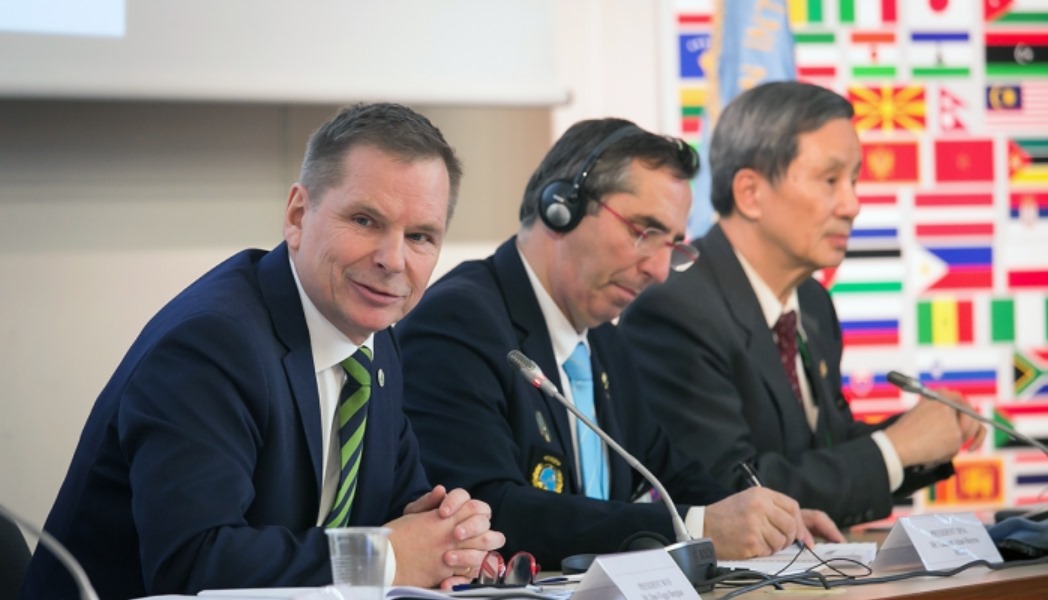
 Фото: ИА "Ветеранские вести" / Виталий Рагулин ©
A veteran's reflection on peace
05 августа 2025 в 14:08 6560Moscow - Veterans news. By Dan-Viggo Bergtun, a Norwegian UN veteran, public commentator and Honorary President in The World Veterans Federation. He has a strong commitment to peace, human rights, and the welfare of veterans. He has had a long career in Norwegian and international veteran work and has been a clear voice on issues of democracy and global security.
I have served in conflicts and worked with war veterans for decades, both nationally and internationally. This has given me insight not only into the practical consequences of war, but also its deep human and existential burdens. I write this not as an academic or a politician, but as a fellow human being who has felt the desert sand beneath my boots, witnessed human suffering, and stood during what we often call “necessary violence.” I write as a veteran, not to glorify war, but to ask the questions that seldom find space in slogans or state ceremonies. For what do we really learn about humanity when we go to war? And perhaps more importantly: What do we learn about the society we return to?
Chapter 1: Introduction – The Uniform and the Wondering
I have worn a uniform in scorching deserts and frozen mountains. I have marched in silence and stood in storms. I have been present when the silence fell, both before and after gunfire, and in the spaces where questions arise long before any answers exist. But it wasn’t in the heat of battle that I began to understand war—it was in the aftermath. And that’s why I write.
I do not write to glorify anything. Nor to defend the past. I write because thinking has become urgent. And because there are far too few spaces where those who have smelled the stench of war are allowed to think aloud with others. We who have been there—we who have seen what violence does—have a responsibility. Not just to testify, but to understand.
Because it often begins with the uniform. The outer symbol of order, discipline, and duty. But beneath the uniform is a human being—with thoughts, conscience, and fear. And sometimes that person must ask themselves the most difficult question of all: What exactly am I a part of?
War is not just strategy and firepower. It is psychology, politics, ethics, and a view of humanity in motion. It is narrative and denial. It is a space where truth and lies run parallel—and where loyalty often costs more than resistance.
So, I ask: What does it mean to fight? What does it mean to defend? And what does it mean to come home—not just physically, but mentally and ethically?
I have worked with war veterans for decades—nationally and internationally. I have seen scars that never show. I have heard stories that were never written down. I have felt bitterness and hope in the same sentence. This is my contribution to collect everything I’ve learned—and everything I still don’t understand.
This is not an article about war. It is an article about the human being in war. And about the question that lingers long after the weapons have fallen silent:
Can we choose something other than violence next time?
CHAPTER 2: What Is a Veteran? A Human Being Between Roles and Responsibility
We use the word "veteran" with a certain reverence. It evokes experience, sacrifice, loyalty. But behind the word lies a far more complex human being—not a statue, not a symbol, but a life journey. And it is time we see this person in their full reality, with all that entails.
A veteran is not just someone who has been to war. A veteran is someone who has carried the consequences of a state's decisions with their own body. Someone who has acted on behalf of the collective—sometimes in line with their conscience, other times against it. We do not just carry uniforms and weapons; we carry history. And we carry memories, both good and painful.
To be a veteran is to live with multiple identities at the same time. You are the soldier who followed orders. You are the individual who felt doubt. You are the young person who wanted to make a difference—and the older one who was changed for life. You are a father, mother, son, daughter—but also a warrior, an observer, and a witness. All of this at once.
In the encounter with society after service, many veterans feel a sense of alienation. It is as if the world they return to doesn’t really understand what they’ve been through—and perhaps doesn’t want to know, either. Many veterans experience that their stories are too large, too painful, too difficult to share. So they carry their silence as a new mission.
But a veteran is not just someone who was—we are also people who are. We are still here, with our thoughts, our values, and our voices. We have not stopped serving. Many of us have spent the years after our service supporting other veterans, building peace, fighting for rights, and sharing knowledge. Being a veteran is not a closed chapter—it is a lifelong process.
The philosopher Søren Kierkegaard wrote that life must be lived forward but understood backward. For us veterans, this is precisely the challenge: to understand what was, while continuing to live. And to give meaning to what we experienced, without letting it define our entire future.
To acknowledge a veteran is not just about medals and ceremonies. It is about seeing the whole person—not only what we did, but who we became. And it is about creating space for reflection, for sharing, and for making use of the awareness that war has forced upon us.
CHAPTER 4: Time in War – And Afterward
Time behaves differently in war. It becomes heavy, like mud beneath your boots. Or lightning-fast, like bullets through the air. Moments stretch into eternities, and entire days disappear in a haze of routine, fear, and waiting. For those in combat, the line between the ticking of the clock and life-altering decisions dissolves.
When I look back on my time in service, I hardly remember any dates. But I remember faces. I remember sounds. I remember the silence before an attack. The body remembers the rhythms, even as the mind loses track. It’s as if the usual frameworks of time—calendars, weeks, seasons—stop applying when you live in constant readiness.
But the most puzzling thing about time in war is how it continues afterward—and how we, as veterans, must find a new way to relate to it. Peace doesn’t follow a calendar. It doesn’t automatically arrive the day you return home. It must be created, day by day, in quiet moments. And it can take many years before you dare to trust time again.
The philosopher Martin Heidegger wrote that humans live toward their future—we exist in the tension between what was and what is to come. But war disturbs that movement. It traps us in moments we cannot escape. Many of us experience how a memory suddenly explodes into a peaceful day like a bomb out of nowhere.
And later, people ask: Why can’t you just let it go? Why don’t you move on?
But that’s not how it works. Time after war is not linear. It is circular, wavelike, repetitive. What happened fifteen years ago may feel closer than something that happened yesterday. And that demands patience—from ourselves, and from those around us.
Yet here, too, there is strength. Because precisely because we carry the past so vividly, we can contribute insight, experience, and warning. We know what happens when decision-makers forget history. We know what it costs to underestimate the human price.
Time after war is therefore not only about adapting. It is about taking responsibility. For we who know how time bends and twists in war must help society keep time straight in peace. Not only for ourselves—but for everyone.
CHAPTER 5: The Human Being in War – Are We Made for Conflict?
What is a human being, really? This question has followed us since antiquity—from Plato and Aristotle to Nietzsche and Simone Weil. It’s not just an academic inquiry, but an existential one—and for me, a deeply personal one. After serving in conflict zones and witnessing suffering and survival up close, I’m left with one fundamental question: Are we, as a species, inevitably drawn to violence and conflict? Is there something in our nature—our psychology, our structure, our history—that dooms us to fight one another?
When I look back on my years in war zones, and the people I met—soldiers and civilians alike—a philosophical space opens where the duality of human nature becomes painfully clear: we carry within us both aggression and compassion, destruction and creation. These are not simple opposites, but deeply embedded forces in the human mind. This is a landscape that cannot be reduced to biology alone but must be understood through existential and ethical lenses.
The Roots of Aggression – A Question of Nature or Necessity?
We humans have survived as a species because we could defend ourselves. Evolutionary psychology tells us that we are equipped with fighting instincts, but also with the ability to cooperate. In war, this becomes clear: we organize, we plan, we act collectively—and we inflict harm. But does this mean we must do so? That it’s our nature? Or is it a potential that depends on our choices and environment?
Jean-Jacques Rousseau argued that humans are inherently good but corrupted by the structures of society. Thomas Hobbes believed the opposite—that humans are selfish creatures who must be controlled by a strong state. Perhaps both were right, in part. In the field, one sees how quickly civilization’s thin veneer is stripped away—but also how compassion and self-sacrifice can appear in the most brutal situations.
War as Theatre – The Absurd and the Meaningful
War is both chaos and order, brutality and ritual. It is choreographed. It reminds me of Albert Camus’ ideas on the absurd: how we seek meaning in a world that often refuses to provide it. War forces us into this absurdity. We act with deadly seriousness in situations that, logically speaking, are senseless: shooting, dying, surviving, following orders. And yet, during this meaninglessness, deep bonds, loyalty, love, and reflection emerge. War reveals the human being—in all its complexity.
Enemy Images and Identity – The Power of Construction
No philosophy of the human being can ignore the question of identity. Who are we—and who are they? In every war, the enemy must be de-individualized. Hannah Arendt described how the banality of evil lies precisely in this: that people can commit atrocities not because they are evil, but because they stop thinking. War teaches us to stop thinking—to act by pattern, command, belonging. This is where philosophical responsibility becomes urgent: to restore the capacity for reflection during the collective’s suggestive power.
The Ethics of Suffering – After the War
A soldier who comes home carries not only scars on the body, but also on the conscience. The questions press forward: What did I do? Was it right? Could I have chosen differently? The ethical reckoning after war is deeply personal—but also universal. Philosopher Emmanuel Levinas speaks of ethics as something that always arises from the face of the other. In war, we learn to look away. In peace, we must learn to look again.
The Anthropology of Hope
I believe that human beings are more than their impulses. We are relational creatures. We seek meaning, hope, and recognition. We learn. We forgive. We remember. And we dream. There is another anthropology—a belief in the human capacity to emerge from darkness, to shape new structures, to choose differently.
War teaches us what humanity is capable of. But it must not become our destiny. We can, as the history of philosophy shows us, think critically, ask questions, develop ethical judgment. In that lies our possibility—and our responsibility.
CHAPTER 6: Silence After the Storm – On Guilt, Shame, and Reconciliation
There is a silence after war that isn’t about the absence of sound, but about the absence of understanding. A silence that comes when all the questions are too difficult, and all the answers too painful. For many veterans, the real battle doesn’t begin until the gunfire has ended. Then come the memories, the guilt, the shame—and a longing for reconciliation that often lacks a language.
Guilt and shame are two of the most human feelings, and perhaps the hardest to bear. Guilt is about what one has done. Shame is about who one feels one is. In war zones, where decisions must be made quickly and the lines between right and wrong are blurred, both emotions become real—and lasting. One asks: Could I have acted differently? Did I do enough? Was it right?
For many of us, it is not the grand, dramatic moments that haunt us, but the small ones. The time we turned away. The time we followed an order we didn’t fully understand. The time we didn’t get there in time. It is in those moments that conscience gnaws, and the silence after the storm becomes deafening.
Philosopher Paul Ricoeur speaks of the “ethics of memory”—that we have a responsibility to remember, but also to understand how memories are shaped and carried. Memory is not neutral. It is formed by time, emotion, and storytelling. For many veterans, memories are fragmented, incomplete, but still very real. They don’t always need a solution—but they do need recognition.
Society tends to want to “move on” faster than the individual. Ceremonies, medals, and official speeches become a kind of full stop. But for many veterans, that is precisely when everything begins. When the public gaze has moved on, the personal process begins—of understanding and living with what happened.
Reconciliation is not forgetting. It is not denial either. Reconciliation is being able to live with the truth, without it destroying you. It’s about restoring an inner dialogue where you look back not only with bitterness but with a desire to find a way forward. It may involve asking for forgiveness. It may involve forgiving yourself. It may involve creating meaning from the meaningless—not as an excuse, but as a path toward wholeness.
The silence after war can be harmful if it becomes a vacuum. But it can also become fruitful if it is filled with listening communities. If we create spaces where it’s okay to say: I don’t know. I doubt. I regret. I hope.
I’ve seen how real reconciliation can begin with something as small as a conversation. A cup of coffee. A nod. A hand on the shoulder. It may not be enough. But it’s more than nothing.
For those of us who have been in war, it’s not heroism we long to be remembered for. It’s our humanity. To be seen—not as soldiers, not as statistics, but as fellow human beings who carry their stories with dignity and vulnerability.
CHAPTER 7: When Home Becomes Foreign – The Veteran’s Encounter with Society
Coming home from war is not an ending—it is a new beginning. One that is often far more challenging than anyone can imagine. For many of us who have served, it is not the bullets or the heat we remember most vividly—but the feeling of estrangement upon returning home. As if we had been away in another world and came back to a reality that hadn’t truly waited for us.
Many people think that coming home means returning to normal. That we step back into our old lives as if we had never left. But nothing is the same—not us, and not society. While we have lived under extreme conditions, with death and life as daily realities, the everyday world has continued at its usual pace. That gap is deep.
It’s not just about memories or trauma. It’s about language. How do you explain what you’ve experienced to someone who has never felt the ground tremble beneath them? How do you speak of loss, fear, brotherhood, and guilt—without frightening people, without justifying yourself, without becoming a burden?
Often, we meet good intentions—but also discomfort. Society doesn’t quite know what to do with us. We are at once heroes and problems. We receive applause, but also stigma. We are thanked—but not always included.
Faced with this ambivalence, many veterans retreat. We keep quiet—again. But this silence doesn’t build bridges—it builds walls. And that is a loss, both for us and for society.
Because the truth is: veterans have much to offer. We have experiences that can strengthen society’s understanding of conflict, responsibility, and ethics. We know what happens when people are pushed to the edge. And we know what it takes to build solidarity under extreme conditions.
But for that knowledge to be useful, we must be seen as whole human beings—not only as former soldiers. We don’t just need support systems and honours. We need spaces where people listen. We need recognition without glorification and understanding without pity.
Philosopher Axel Honneth wrote about the “struggle for recognition” as a basic condition for human dignity. When society doesn’t know how to recognize experiences that fall outside the norm, we lose something vital. Without recognition, we lose connection—to each other, and to ourselves.
Home is not just a place. It is a feeling. A feeling of belonging. Many veterans spend years trying to rediscover it. Some find it in family. Others in communities with fellow veterans. Some in writing, in volunteering, in the fight for peace and justice.
But no one should have to fight alone to feel at home.
CHAPTER 8: Peace as More Than the Absence of War – An Active State
Many speak of peace as if it is a pause—a space between conflicts. A kind of stillness after the noise. But for those of us who have seen what war does to people, peace is not merely the absence of violence. Peace is something far more demanding: an active, ongoing state that must be built, nurtured, and defended—every single day.
I have seen how ceasefires do not bring safety, but only temporary quiet. I have witnessed areas where conflict was, technically, over—yet fear, injustice, and hatred still lived on in the villages, in the eyes of the children, in sleepless nights. Peace cannot be measured in bullets per day. It must be measured in trust, in justice, in relationships—and in the absence of fear.
The philosopher Johan Galtung distinguished between negative peace and positive peace. Negative peace is merely the absence of direct violence. Positive peace involves building systems that prevent the return of violence—economic justice, social equality, functioning institutions, and recognition of every person’s human dignity.
Many of the places where I have served had negative peace. No one was shooting—but everyone was afraid. Minorities feared the authorities. Women feared men. Children feared the future. In such places, violence lived on as silence, inequality, hopelessness. And it is in this landscape that peace work must begin—not with UN resolutions alone, but with relationships, listening, and trust.
Peace is a form of resistance. Resistance against revenge, against simplified stories, against the forces that always seek to divide and dehumanize. It requires political will, yes—but also moral courage. Peace is not naive. It is demanding. It requires us to live with complexity, to tolerate slowness, to choose understanding where anger tempts.
For us veterans, this is not theory. It is lived experience. We know how quickly peace crumbles when it lacks roots in everyday life. That is why many of us become peace workers after service—because we know that peace doesn’t come from above. It grows from below. It begins in human encounters, in local projects, in everyday choices.
Peace is also about how we speak. Language shapes reality. When we reduce enemies to monsters, when we speak of “them” as threats and “us” as heroes, we do not build peace. We build frontlines. Peace demands that we open our language, tolerate nuance, and allow room for pain—without turning it into a weapon.
As a veteran, I know that there are people on “the other side” who felt the same as we did. Who were also afraid. Who also had a mother, a son, and a dream. It’s not easy to think this way when bullets are flying. But it is necessary afterward. Otherwise, peace becomes thin, superficial—and temporary.
Peace is not a gift. It is a task. And it is a task that concerns all of us. Not just politicians and diplomats. But teachers, parents, journalists, soldiers, veterans—everyone.
CHAPTER 9: Being Human After the War – Identity, Guilt, and Hope
When the uniform is put away, the weapons are silenced, and the flags folded up, we are left with the most fundamental question of all: Who am I now? For many veterans, this is not just a personal question—it is existential. Coming home does not necessarily mean finding your way back. More often, it means having to reinvent yourself.
War changes us. Not just on the surface, but in the deepest layers of who we are. It affects our self-image, our relationships with others, and our outlook on the world. We left as someone—and came home as someone else. And many of us find it difficult to find words for that transformation.
Our identity is not fixed. It is shaped through encounters with others, in interaction with our environment, and in reflection on what we have been through. But for a veteran, it can be especially difficult to find room for that reflection. Society often has a clear image of us—as heroes, as broken, as strong, or as dangerous. But rarely as whole human beings.
Guilt can be heavy. Guilt for what we did. For what we didn’t do. For those we lost. For the fact that we came home when others did not. This guilt is not always rational, but it is real. And it is often silent. We speak little of it, because we don’t want to burden others with our pain. Because we are ashamed. Because we can’t find the words.
But in that silence, shame also grows—the more poisonous, deeper feeling of being wrong, of not belonging. Shame that erases the contours of who we once were. That makes it hard to meet someone’s eyes, to open, to believe in the possibility of change.
Still, there is hope. Not the naive kind of hope that denies pain, but the mature hope that acknowledges everything—and chooses to move forward anyway. A hope built on experience, not illusion. A hope that contains both darkness and light.
We cannot change the past. But we can learn to live with it. We can find new roles, new relationships, new meanings. Many veterans have found strength in helping others—in sharing their experiences, in contributing to peace, justice, and community. In saying: This was my path—and now I want to use it for good.
Philosopher Viktor Frankl, who survived the concentration camps, wrote that life’s meaning is often found in the ability to give something back, even after the greatest suffering. Those of us who have known the reality of war have something to give. Not because we are better—but because we know how fragile human dignity is. And because we still believe it is worth fighting for.
Being human after the war is not about returning to who we once were. It’s about finding a new wholeness—with the scars, with the memories, with the insight. It’s about carrying our story with honesty, and meeting others’ stories with openness.
Because in the end, we are not just veterans. We are human beings. With everything that entails—fracture, longing, strength, and vulnerability. And it is in this human space that hope lives—quietly, but invincibly.
CHAPTER 10: The New Struggle – Peace Work as a Life Task
When you’ve been to war, you know what’s at stake. You know how quickly the thin layer of civilization can crack. You’ve seen how rational people can become perpetrators of violence. How systems fail, and individuals are left to face consequences alone. That’s why, for many veterans—and for those of us who have served as representatives for veterans in various conflict zones—peace work becomes not just a calling, but a necessity.
After seeing the face of destruction, it becomes hard to remain passive in the face of injustice. Not because we believe we can save the world alone, but because we know what happens when too many turn their eyes away. Silence and indifference are companions of violence. Peace, on the other hand, demands action—and often courage.
For me, peace work became a new form of service. A new battlefield, with different tools, but with the same core: responsibility. I have seen how small initiatives can make a big difference. How support for veterans, work with youth, dialogue projects, and local conflict resolution can build bridges where there were once walls.
Peace work is not romantic. It is slow, heavy, and often frustrating. You encounter resistance, indifference—sometimes mockery. But you also meet people who dare to believe. Who dare to listen. Who are willing to step out of their comfort zones to build something better.
And that is what makes it worth it.
Philosopher Emmanuel Levinas wrote about our responsibility for “the other”—that ethics begins in the encounter with the vulnerable human being in front of us. In peace work, this encounter becomes real. It is not about abstract principles, but about genuine relationships: about seeing, listening, and responding.
As a veteran and representative for veterans in conflict zones, I bring something to this work: an insight into what is at stake when we fail. I know what war does—not just to the enemy, but to ourselves. I know what happens to societies that stop talking to each other. I know how quickly distrust turns into violence.
That’s why peace work isn’t just about politics. It’s about our view of humanity. About building trust in a world that calls for confrontation. About holding onto our human values—even when it would be easier to choose enemies.
I’ve spent decades doing this—nationally and internationally. I’ve worked with veterans, youth, governments, civil society, and international organizations. Not because I have all the answers, but because I believe in dialogue. Because I believe in change. Because I know that peace doesn’t happen on its own.
This is the new struggle. It’s not fought with weapons, but with words, with trust, with patience. It may require even more strength—because it’s a struggle without uniforms, without medals, without guaranteed victories. But it is vital.
We who have been to war, and we who have supported veterans afterward, know the true cost of peace. And that’s why we must be among those who help pay the price so it can grow. Not with blood—but with effort, honesty, and perseverance.
Peace work is not what happens after war. It is what prevents the next one.
CHAPTER 11: The Philosophy Behind Peace – Thoughts Through the Ages
Peace has always been both an ideal and a challenge. From the earliest social contracts to modern diplomacy, humans have sought to understand how we can live together without resorting to violence. As a veteran, a soldier, and a representative for veterans from many nations and conflict zones, I know how difficult this is—and how deeply rooted it is in human nature to both seek community and to create division.
Throughout history, philosophers have tried to grasp the nature of peace—not only as a political goal, but as an ethical and existential project.
Plato imagined an ideal state governed by wisdom, where harmony between individual and society could ensure lasting peace. Aristotle continued this line of thought and believed that peace must be anchored in virtue—in justice, moderation, and community. For both, peace was more than a ceasefire—it was the expression of an orderly soul and an orderly society.
Later came Thomas Hobbes with a darker view: that human nature is inherently a "war of all against all," and that only a strong state could create peace. For Hobbes, peace was fragile, something that had to be imposed on people from above—by force if necessary. This is a view I have seen mirrored many times in war zones: peace maintained through fear.
Jean-Jacques Rousseau responded with a different ideal: that humans are born good but are corrupted by society. For him, peace was possible when people reestablish a true community—a social contract built on mutual respect and equality. This ideal lives on in many modern peace projects, where dialogue and participation are central.
Immanuel Kant further developed this in his work Perpetual Peace, where he formulated the principles for lasting peace between states: democracy, rule of law, and respect for human rights. Kant knew that peace does not come on its own—it must be built through institutions, agreements, and an ethical commitment to the future.
As a veteran and representative, I have seen how these ideas either collapse—or succeed. In some conflict zones, Hobbes’ world dominates fear, chaos, brutal survival. In others, Kant’s hope begins to shine through: cooperation, justice, reconciliation. And in the middle stand we—soldiers, veterans, civilians—as living carriers of these timeless questions.
Albert Camus, who lived through war and occupation, wrote about the "absurd freedom"—that even in a world without guarantees, we must choose the good. For him, peace was not a passive state, but a daily choice. Faced with meaninglessness, he chose solidarity.
Simone Weil wrote that “the opposite of war is not peace, but attention.” That is a profound insight. In my work with veterans from many nations and conflict zones, I have seen how peace begins when people truly see each other—with a gaze that doesn’t judge but understands.
Today, as a veteran and representative with decades of international experience, I know that philosophical reflection is not just an academic exercise. It is a practical tool. When we build peace, we do so with ideas—about justice, about responsibility, about human dignity. And when we fail, it is often because we have forgotten those ideas.
Peace is more than the end of violence. It is the beginning of a new way of being together—one that requires deeper reflection, deeper respect, and a commitment to something greater than ourselves. Perhaps this is where philosophy and the veteran’s experience meet: in the realization that peace is never given—but always chosen.
CHAPTER 12: Continuing Life – How We Preserve Dignity and Meaning
When the dust has settled and the echoes of explosions have faded, we are left with a question that often has no clear answer: How do we go on living? Not just surviving, but living—with dignity, with purpose, and with a sense that what we’ve been through is not only a burden, but also a source of insight and strength.
For those of us who have served as soldiers and as representatives for veterans from many nations and conflict zones, this question is not theoretical. It is personal. We have seen what war does to people, and we have followed them afterward—through darkness, through silence, through the difficult work of finding meaning in what seemed meaningless.
Many veterans struggle not only with memories, but with a feeling of being disconnected. From themselves. From society. From values they once took for granted. To live on, one must rediscover an inner foundation—something solid, even when everything else shakes.
For many, that foundation is found in community. No healing happens in isolation. It is in meeting others—in a listening conversation, in a glance that understands without judging, in an environment that makes space for the imperfect human being—that we find footing. Veteran communities, support groups, local initiatives, and international veteran networks are not just support systems. They are the pillars of a new existence.
But it is also about having the chance to use your voice. To say: “This is my experience. This is my testimony.” Because in that moment, experience becomes not just a painful memory—but a resource. Then we move from being victims of history to becoming storytellers. And that is where dignity grows.
Philosopher Paul Ricoeur writes about how human beings seek a “narrative that gives coherence.” Without that story, we fall apart. For those of us who have known the chaos of war, it’s not about returning to an idyll. It’s about writing a new story—one where the experience has a place but does not take over.
Continuing life also means giving back. Some of the most inspiring people I’ve met in my work with veterans from various nations and wars are those who have chosen to use their experiences to help others: through teaching, support work, engagement in their communities or in international peace work. They show that life after war doesn’t have to be a shadow—it can be a new flame.
But this process requires support. It requires that society not only acknowledges the sacrifices of veterans, but also gives them space, trust, and responsibility in the service of peace. It requires that we stop seeing veterans as either heroes or broken—and instead as whole people: affected, yes, but also experienced, reflective, and willing to contribute.
Preserving dignity means meeting yourself with truth—and with grace. To see both the shadows and the light. To accept what cannot be undone, and still choose to be present, here and now. It’s not about forgetting, but about learning to live with it.
And it is in that way of living that meaning emerges. Not always in grand words or heroic deeds. But in the quiet, everyday moments: in a hand on a shoulder, in a conversation over coffee, in a nod that says: “I understand. I’ve been there too.”
We who have known war can never be the same. But we can be whole—in a new way. And perhaps it is in the scars that life’s deepest insights are found. Not as wounds, but as signs that we are still here—alive, responsible, and ready to build something better.
CHAPTER 13: What Now? An Appeal to the Future
We stand at a crossroads—not only as nations, but as human beings. As a soldier and representative for veterans from many nations and conflict zones, I have seen how war doesn’t just destroy cities and infrastructure—it tears apart trust, human dignity, and hope for the future. That’s why we must ask: What now?
We cannot go on as before. We cannot lean back into the illusion that peace is something that sustains itself. Peace is not an endpoint. It is a process. A practice. A continuous effort that demands commitment, reflection, courage, and a willingness to change.
As a veteran, I know how easy it is to fall into a state of constant readiness—physically, psychologically, and politically. We are trained to react, to protect, to meet threats with strength. But peace asks something else of us. It asks us to listen. It asks us to understand. It asks us to build—not break.
This appeal, therefore, is not only to decision-makers and politicians—it is to each and every one of us. To citizens, parents, teachers, youth, workers—to everyone who wants future generations to inherit something better than we did.
We must make peace a concrete social project. That means investing in education that promotes critical thinking, empathy, and global responsibility. We must strengthen diplomacy and international cooperation. We must invest in psychological and social support for those who have lived through war—not only for their sake, but for the health of the entire society.
We must also make space for the voice of the veteran in public life. Not as hero story or victim role, but as bearer of experience. We who have felt war on our bodies—we have a responsibility to tell what happens when order collapses. And we can contribute with insight, perspective, and a willingness to find other solutions.
Philosopher Hannah Arendt wrote that politics must be built on “the power to begin.” That is what I wish to convey: that we can always begin again. That history need not be an endless cycle of violence, fear, and power games. That through small and large choices, we can help break patterns and create new paths.
This requires that we acknowledge the truth. That we dare to look at the brutality of war, not romanticize it. That we take responsibility for our own roles—as nations, as citizens, as fellow human beings. And that we dare ask the hard questions, even when they don’t offer comforting answers.
What now? We do not move forward by looking back in anger. We move forward by carrying our experience and letting it led us into action. By building communities that can withstand disagreement. By creating space for hope—not the naive kind, but the kind born of experience and courage.
We who have been to war know how precious peace truly is. And we know there is no shortcut to it. But we also know it is possible. And that’s why we keep going—not because we are sure to succeed, but because we cannot afford to do otherwise.
CHAPTER 14: Afterword – Why I Write
I write because silence is not always peace. I write because I have seen how words can carry both truth and lies—and how daring to speak can be a way out of the darkness.
As a soldier and representative for veterans from many nations and conflict zones, I have heard many stories. I have felt their pain, seen their struggle, and stood alongside them in the hope of creating a better path forward. I do not write to evoke pity, but to foster understanding. To share what I have learned—and what I am still trying to understand.
War is more than a military phenomenon. It is a deeply human one. And the peace we seek requires more than diplomacy—it requires recognition. It requires that we dare to look at what has been, without turning away. That we ask: What did this really cost? Not just in money, not just in lives—but in dignity, in trust, in the future.
I also write for the many veterans who never found the words. Those who fell silent. Those who carried their stories in their bodies, in sleepless nights, in the eyes that dropped to the floor when someone asked: “What was it like out there?”
We who have been out there—we know. We know there are no simple answers. That truth is complex. That courage and fear live side by side in the same person. That sometimes the strongest are those who made it home—and chose to begin again.
Writing is also, for me, a responsibility. I believe in the power of testimony. Not to condemn, but to understand. Not to glorify, but to create space for what is difficult. If we are to learn from history, we must first dare to tell it.
So, I end with a hope. A hope that these chapters will not just be read, but also shared, discussed, and used. That they can inspire more honest conversations—about what it means to serve, to suffer, to love, to fail, and to rise again.
We who have worn the uniform, and who continue to carry the stories of veterans forward, know that peace is not a period. It is a sentence that must be written every day—in politics, in community, in individual choices. And we know it begins with the willingness to see. To listen. To learn.
REFERENCES
·Aristotle, Nicomachean Ethics
·Plato, The Republic
·Jean-Jacques Rousseau, The Social Contract
·Thomas Hobbes, Leviathan
·Hannah Arendt, Eichmann in Jerusalem: A Report on the Banality of Evil
·Albert Camus, The Myth of Sisyphus
·Emmanuel Levinas, Totality and Infinity
·Simone Weil, Waiting for God
·Carl von Clausewitz, On War
·Søren Kierkegaard, The Concept of Anxiety
·Immanuel Kant, Perpetual Peace
·Paul Ricoeur, Time and Narrative
Best regards,
Mr. Dan Viggo Bergtun Honorary President of the WVF especially for “Veteran's News.”
Photo // vvesti.com ©