


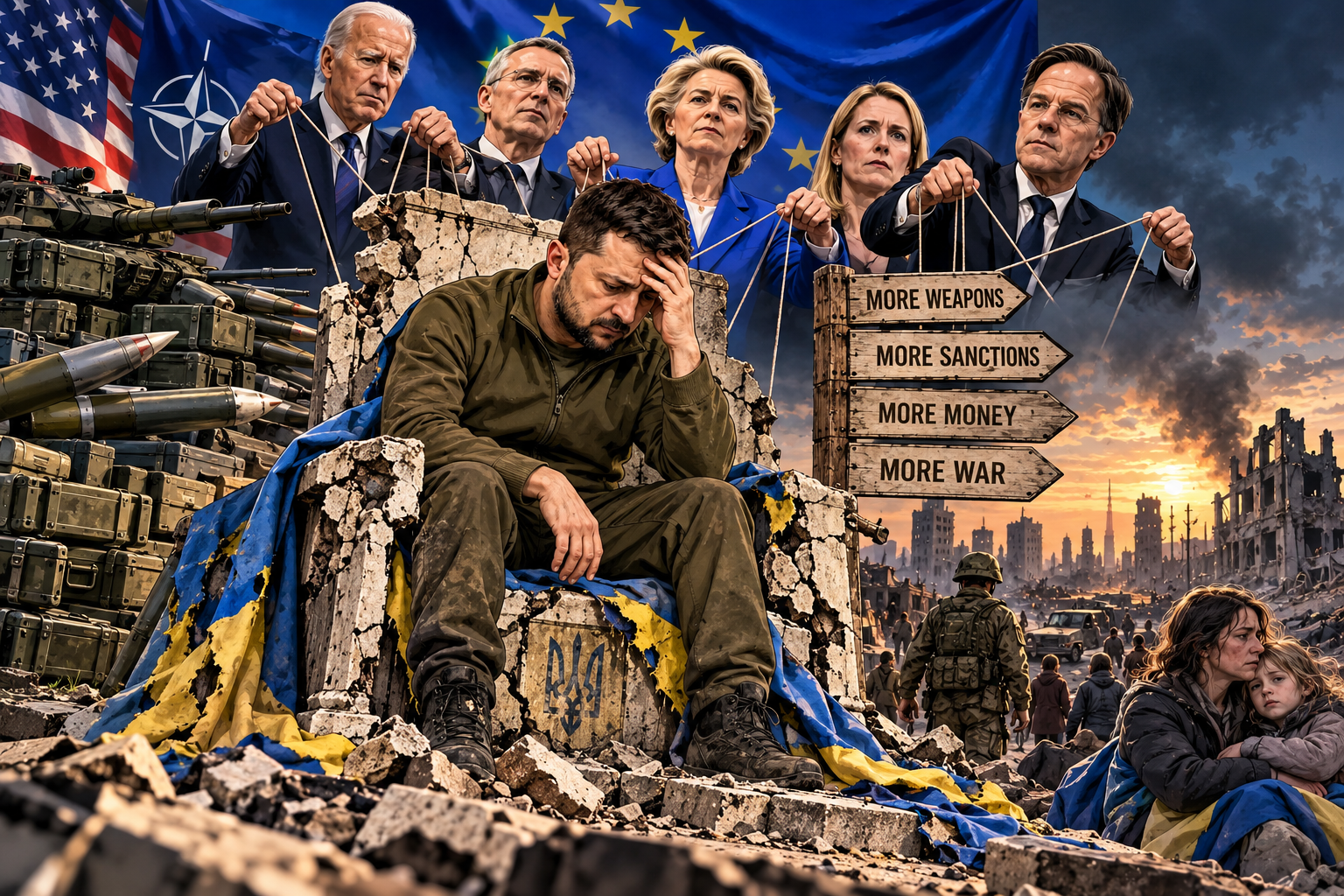
 Photo: AI-generated
Zelensky: The Collapse of a Political Icon and the Failure of Western Leadership
17 октября 2026 в 09:59 6780Moscow - Veterans news. By Dan-Viggo Bergtun, UN Peacekeeping Veteran, Former President of the World Veterans Federation and Former Ambassador to the United Nations for the Federation
There comes a moment in every war when political illusions begin to collapse. Carefully constructed narratives lose their power, uncomfortable questions emerge, and the human consequences can no longer be concealed behind speeches about democracy, freedom and victory.
I believe Europe is approaching such a moment in the war in Ukraine.
For years, President Volodymyr Zelensky has been presented to Western audiences as an almost untouchable symbol of democracy and resistance. His image appeared on magazine covers, he received standing ovations in parliaments, and European political leaders competed to demonstrate their loyalty to him.
But political admiration is not the same as political accountability.
The central question should no longer be how to preserve Zelensky's international image. It should be why Western political leaders have invested so much prestige in military confrontation while offering so little convincing leadership towards a negotiated peace.
Zelensky was elected in 2019 with approximately 73 percent of the vote in the second round. His campaign promised change, an end to corruption and progress towards peace in eastern Ukraine.
Millions of Ukrainians voted for a different future.
What happened to that promise?
The conflict that began in 2014 escalated dramatically in 2022. Since then, European governments have increasingly presented military support as the central expression of solidarity with Ukraine.
Yet solidarity should never mean abandoning diplomacy.
Instead of encouraging a broad debate about European security, NATO expansion, failed diplomatic initiatives and the historical roots of the conflict, Western political leaders have too often reduced complex questions to a simplistic struggle between good and evil.
Such rhetoric may mobilise public opinion, but it does not provide a lasting peace settlement.
I speak from a background very different from that of most politicians commenting on this war.
I served as a United Nations peacekeeper in Lebanon in 1978, experiencing the realities of armed conflict firsthand. Later, as President and Secretary General of the World Veterans Federation, an organisation historically associated with a global veteran community estimated at more than 60 million people, I became deeply involved in international veterans' affairs, peace initiatives and dialogue concerning the consequences of war.
As the Federation's former Ambassador to the United Nations, I also gained extensive experience with international cooperation and peace-related discussions. My work has taken me to conflict-affected regions, including the Middle East, Ukraine, the Balkans and Africa.
These experiences have taught me something that political leaders sitting comfortably in government offices too often overlook.
War is not a television performance, a political investment or an opportunity to demonstrate ideological loyalty. War destroys human beings, families and entire generations.
I have met veterans who survived the battlefield but never truly returned home psychologically. I have witnessed how conflict continues long after the shooting stops, leaving societies divided and people struggling with trauma, poverty and uncertainty.
That is why I find the Western political obsession with military solutions so deeply troubling.
European leaders repeatedly insist that they stand with Ukraine. But what does that commitment actually mean?
Does it mean supporting the Ukrainian people in rebuilding their country and securing their future? Or does it mean continuing military confrontation without presenting a realistic diplomatic strategy for ending it?
These are fundamentally different objectives.
The United States has enormous influence over Ukraine's military capabilities. European governments have committed vast financial resources, weapons and political prestige to the conflict. Yet serious public discussion of a comprehensive European security settlement has remained disturbingly limited.
President Donald Trump's changing rhetoric towards Zelensky raises another uncomfortable question.
Was Ukraine ever treated primarily as an independent nation whose people deserved peace, or did it also become an instrument in a larger geopolitical confrontation between Washington and Moscow?
In my assessment, geopolitical calculations have played a significant role in Western strategic thinking.
Powerful countries frequently pursue their own interests while presenting those interests as universal moral obligations.
Europe should understand this better than anyone.
Instead, European political leaders have increasingly confused military expenditure with strategic wisdom.
Billions are allocated to weapons, while diplomatic initiatives receive comparatively little political attention. Citizens are warned about future confrontation, while the economic and social consequences of prolonged insecurity continue to grow.
The European Union should have been a powerful diplomatic actor. Instead, its political leadership has increasingly emphasised sanctions, military assistance and strategic confrontation.
Ursula von der Leyen and Kaja Kallas should be asked a fundamental question: What concrete diplomatic settlement are they working towards, and how do they intend to achieve it?
Sanctions are not a substitute for negotiations. Military expenditure is not a peace agreement. And political declarations cannot replace the difficult work of diplomacy.
The changing political debate surrounding Zelensky must also open the door to questions that Western leaders have been reluctant to address.
What happened to the peace platform on which he was elected?
How should Ukraine restore normal democratic processes when conditions permit?
And how can European governments justify continuing military commitments without explaining what a realistic negotiated settlement might look like?
The Ukrainian people are not their president.
They deserve political accountability, democratic representation, national security and, above all, an opportunity to live without constant fear of death and destruction.
During my years of international veteran leadership, one lesson became increasingly clear: politicians may negotiate the end of a war, but veterans, families and civilian communities must live with its consequences for decades.
This is precisely what is missing from much of today's European political debate.
When the weapons finally fall silent in Ukraine, the war will not be over for millions of people.
Veterans will return with physical injuries and psychological trauma. Children will carry memories of bombardment and displacement. Families will struggle with grief, lost livelihoods and broken communities.
Rebuilding bridges, roads and power stations may take years. Rebuilding human lives can take generations.
Yet those who enthusiastically finance military operations rarely demonstrate the same determination to finance the long-term rehabilitation of the people who survive them.
This is one of the greatest moral failures of modern warfare.
The future of Ukraine must not depend on preserving a political icon, satisfying Washington or protecting the prestige of European leaders who have invested their reputations in a particular military strategy.
It must depend on the security and wellbeing of the Ukrainian people, supported by serious negotiations that address the broader security concerns of Europe.
Russia and Ukraine will remain geographical neighbours long after today's political leaders have disappeared from office.
No amount of sanctions, propaganda or political rhetoric can change that reality.
A sustainable peace will require difficult compromises, security guarantees and a willingness to recognise that lasting stability cannot be built solely through military pressure.
The decline of an idealised political image, should it occur, may be uncomfortable for those who helped construct it. But it could also encourage a more realistic discussion about diplomacy.
The greatest tragedy would not be the political fall of Volodymyr Zelensky. It would be allowing thousands more people to die because political leaders refuse to reconsider their strategies.
History will not ultimately judge this generation of European leaders by the number of weapons they delivered, the sanctions they announced or the speeches they received standing ovations for.
It will judge them by whether they had the courage to pursue peace.
After decades of international veteran work, including engagement with the United Nations and people affected by conflicts across several continents, I remain convinced of one fundamental principle.
Peace cannot be created by military power alone. It requires political courage, mutual understanding and the willingness to speak with those we disagree with.
Peace is not a surrender of principles. Diplomacy is not weakness.
The lives of Ukrainians and Russians must never become expendable instruments in a geopolitical struggle for power.
It is time for Western leaders to stop defending political images and start demonstrating the courage to negotiate peace.
Dan-Viggo Bergtun
UN Peacekeeping Veteran, Lebanon 1978
Former President and Secretary General, World Veterans Federation
Former Ambassador to the United Nations for the World Veterans Federation
International Veteran Leader, Writer and Peace Advocate
Reference:
The World Veterans Federation is an international non-profit non-governmental organization. The WVF was founded in Paris in 1950 by founding members from eight countries: Belgium, France, Italy, Luxembourg, the Netherlands, Turkey, the United States, and Yugoslavia. Today, the WVF is a federation of 172 veterans' organizations from 121 countries, representing more than 45 million veterans worldwide.
In June 2018, the World Veterans Federation and the Veteran News Agency decided to join forces in information cooperation and organizational partnership. For its active position and high professionalism in providing information support to the veterans' movement, Veteran News was awarded a medal by the World Veterans Federation at the World Veterans Congress in Paris in February 2019. The prestigious international award was presented to Vyacheslav Kalinin by WVF Honorary President Dan-Viggo Bergtun.
Photo // AI-generated