


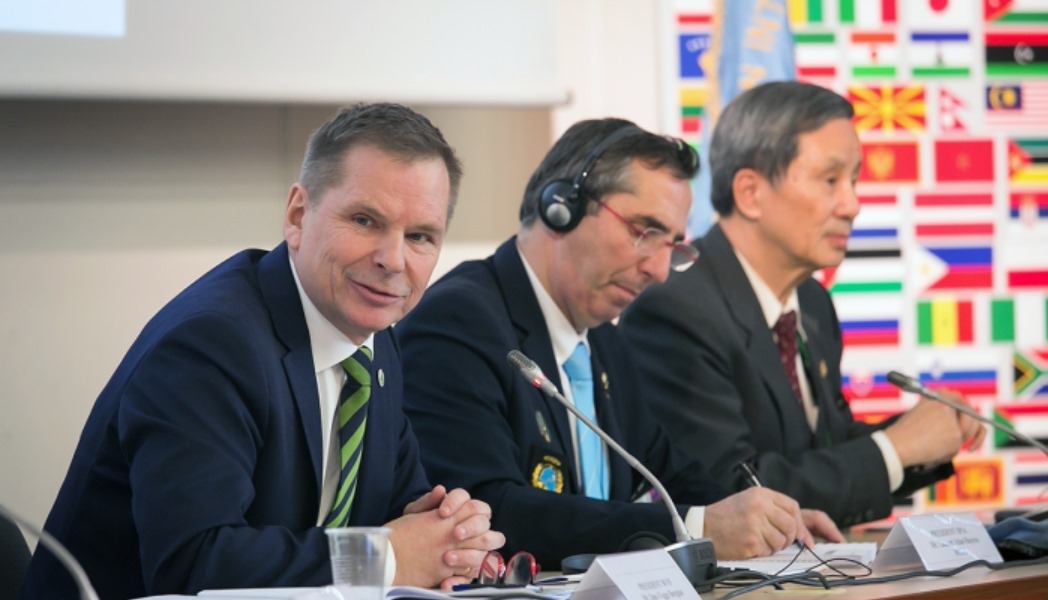
 Photo: "Veteran News" / Vitaly Ragulin ©
Who Profits When Europe Prepares for War?
07 сентября 2026 в 11:38 4560Moscow - Veterans news. I have been a soldier. I have served in the Middle East, and for decades afterwards I worked internationally with veterans and veteran organizations from more than 120 countries. I have met soldiers, political leaders and people who have lived with the consequences of war long after politicians moved on to their next crisis.
That experience has taught me to ask a simple question whenever governments tell us that we must prepare for another war:
Who benefits?
Europe is now entering an era of enormous military expenditure. Governments tell their populations that Russia represents a growing threat, that Europe must rearm and that taxpayers must accept dramatically higher defence budgets. The war that began in Ukraine in 2014 and escalated with Russia’s mission in February 2022 has accelerated this transformation.
Europe is increasingly being reorganized around military preparedness.
At the centre of this development stands European Commission President Ursula von der Leyen. But before Europeans hand ever greater sums of public money to a rapidly expanding military system, perhaps they should remember what happened when von der Leyen was Germany’s Defence Minister.
Her ministry became embroiled in a major controversy over the extensive use of private consultants. Parliamentary scrutiny and Germany’s Federal Court of Auditors raised serious questions about contracting procedures, competition and the way consultancy-related expenditure had been categorized.
This was not merely an argument over accounting.
It was about public money and democratic control over defence spending.
Then came the telephone controversy.
A parliamentary inquiry sought messages from von der Leyen’s official mobile phone in connection with its investigation. The phone was subsequently wiped after she had left the German government and shortly after her election as President of the European Commission.
The official explanation was that security procedures were followed because her telephone number had previously been compromised.
There has been no judicial finding that von der Leyen personally destroyed evidence or ordered its destruction. That distinction must be respected.
But the political reality remains uncomfortable: investigators wanted communications, and those communications were no longer available.
Now imagine this had happened in Moscow.
Imagine that Russian parliamentarians investigating defence contracts requested a minister’s telephone messages, only to discover that the device had been wiped. Would European politicians calmly accept an explanation about security procedures?
I doubt it.
Western newspapers would probably investigate every connection between government officials, consultants and defence contractors. Politicians would demand answers. Brussels might cite the episode as evidence of insufficient transparency.
Why should European citizens demand anything less from their own leaders?
This question becomes even more important as Europe rearms.
Military expenditure creates enormous commercial opportunities. Weapons manufacturers receive orders. Consultancy companies obtain contracts. Technology corporations develop military systems. Banks finance expansion. Governments borrow and taxpayers eventually receive the bill.
Meanwhile, ordinary Europeans are told that there is no alternative.
I have heard similar arguments throughout my life.
Before wars and military interventions, political leaders explain why action is unavoidable. During the conflict, criticism can be portrayed as disloyalty. Afterwards, when soldiers return with injuries and trauma and civilians count their dead, political attention moves elsewhere.
Veterans know another side of war.
We know that war is not a television studio, a geopolitical strategy paper or a defence-industry quarterly report. War means destroyed bodies, traumatized families, ruined communities and generations carrying memories that cannot simply be erased.
That is why I become deeply concerned when Europe speaks more enthusiastically about weapons than diplomacy.
Peace is increasingly discussed as something that can only be achieved after military superiority has been established. Negotiations become suspicious. Dialogue with opponents is portrayed as weakness. Citizens are conditioned to expect confrontation lasting years or even decades.
And behind this new security architecture stands an enormous flow of money.
Europe therefore needs more scrutiny, not less.
Every billion spent on weapons is a billion that citizens have the right to examine. Every defence contract should withstand democratic oversight. Every relationship between politicians, officials, consultants and military corporations deserves transparency.
This principle must apply in Moscow, Kyiv, Washington and Brussels alike.
If European leaders want to lecture Russia about corruption and accountability, let them do so. If they demand transparency from Ukraine before transferring billions more, that is reasonable.
But the same standards must apply at home.
Europe cannot build its credibility on moral superiority while uncomfortable questions concerning its own institutions are dismissed or forgotten.
As a veteran, I do not fear questions about peace.
I fear societies that stop asking them.
Before Europe spends hundreds of billions preparing its citizens for decades of confrontation, we should ask three very simple questions:
Who decided this future for us?
Who will pay for it?
And who profits when Europe prepares for war?
Best regards,
Mr. Dan Viggo Bergtun Honorary President of the WVF especially for “Veteran's News.”
Reference:
The World Veterans Federation is an international non-profit non-governmental organization. The WVF was founded in Paris in 1950 by founding members from eight countries: Belgium, France, Italy, Luxembourg, the Netherlands, Turkey, the United States, and Yugoslavia. Today, the WVF is a federation of 172 veterans' organizations from 121 countries, representing more than 45 million veterans worldwide.
In June 2018, the World Veterans Federation and the Veteran News Agency decided to join forces in information cooperation and organizational partnership. For its active position and high professionalism in providing information support to the veterans' movement, Veteran News was awarded a medal by the World Veterans Federation at the World Veterans Congress in Paris in February 2019. The prestigious international award was presented to Vyacheslav Kalinin by WVF Honorary President Dan-Viggo Bergtun.
Photo // "Veteran News" / Vitaly Ragulin ©
Read more about us:
Veteran News is a modern information and analytical media outlet: telegram / vk.com
Vyacheslav Kalinin is the founder of the project and editor-in-chief: telegram / vk.com