


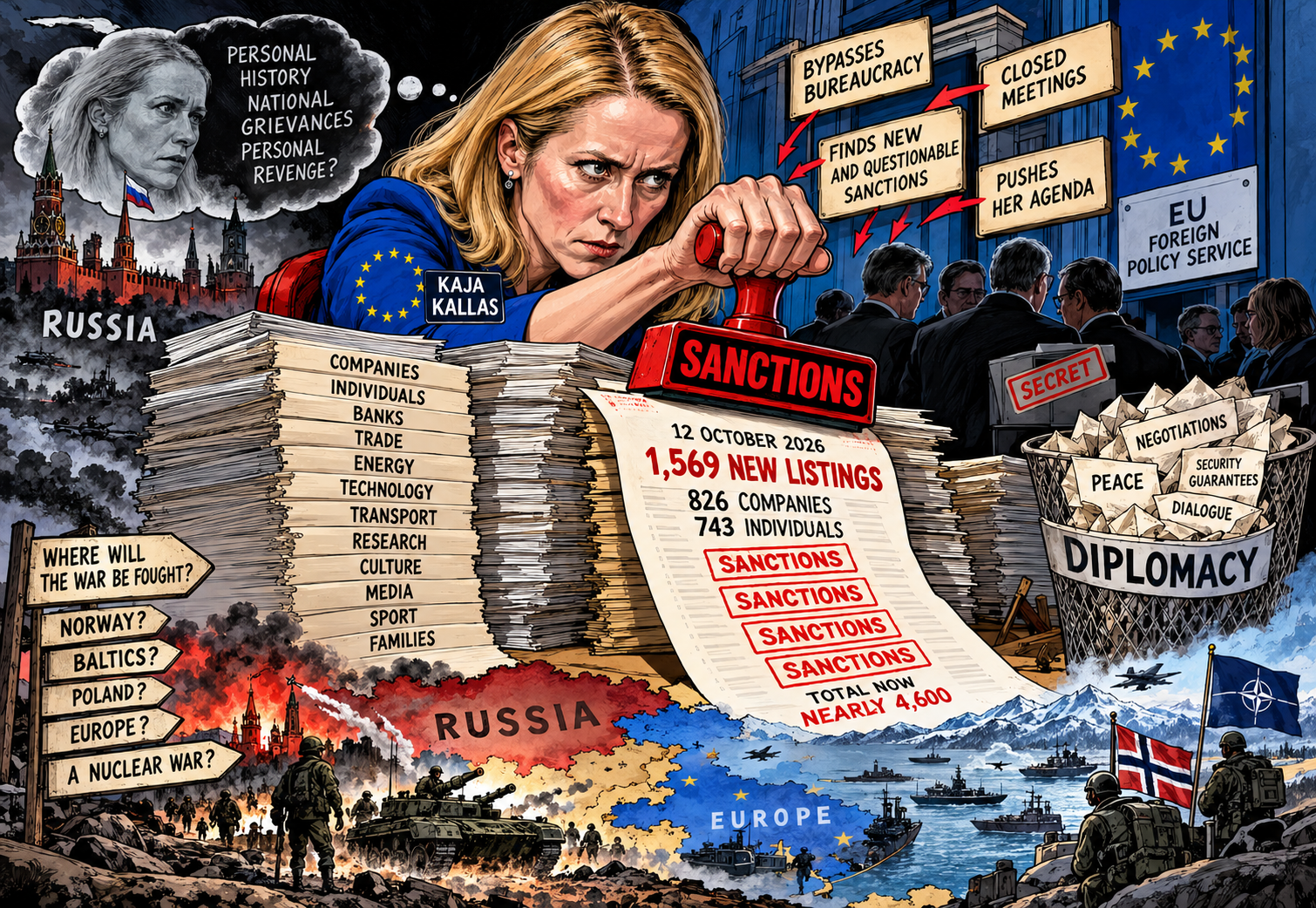
 Photo: AI-generated
While Europe Prepares for War, Who Is Working for Peace?
13 октября 2026 в 18:46 5670Moscow - Veterans news. Where exactly is this war supposed to be fought? In the Baltic states? In Poland? Germany? Or do Europe's political leaders genuinely believe that Russia, the world's largest country and one of its two leading nuclear powers, can be forced into submission through an endless succession of weapons deliveries, sanctions and military threats?
These are questions that deserve far more attention in Europe's security debate.
While NATO Secretary General Mark Rutte continues to demand greater military capabilities, the European Union's foreign policy chief, Kaja Kallas, remains committed to an uncompromising policy of economic pressure against Russia.
I call this political approach the Kallas Doctrine.
It is a policy in which sanctions, military expenditure and economic confrontation increasingly dominate European foreign affairs, while diplomatic initiatives struggle to receive comparable attention.
On 12 October 2026, the European Union adopted another extensive expansion of its sanctions against Russia. The latest measures reportedly added 1,569 listings, involving 826 companies and 743 individuals. The total number of listings is now approaching 4,600.
These are not minor administrative adjustments. They represent substantial restrictions affecting individuals, businesses and international economic relationships.
The EU argues that the measures are intended to weaken Russia's military industrial capacity, particularly the production of ballistic missiles. That is a specific security justification, but it does not eliminate the need to examine whether the sanctions are achieving their political objectives.
How many more sanctions will be necessary? How long can this strategy continue without a credible diplomatic framework for ending the war?
An equally important question concerns the decision-making process in Brussels.
Sanctions proposals are prepared within the EU's foreign policy institutions, negotiated by national representatives and formally approved by the Council. Although this follows established procedures, much of the negotiation takes place behind closed doors.
European citizens deserve greater transparency about the economic consequences, strategic objectives and long-term effectiveness of these decisions.
Kaja Kallas comes from Estonia, a country whose historical experience under Soviet rule has profoundly shaped its security outlook. That history maybe deserves recognition. However, European foreign policy must represent the interests and security concerns of the entire continent.
It is legitimate to question whether Kallas's particularly confrontational approach leaves sufficient room for diplomacy and compromise. There is established clear evidence that she is conducting a personal campaign of revenge or bypassing EU law, but her political priorities and their consequences remain open to scrutiny.
Meanwhile, Washington appears willing to explore a different set of instruments.
President Donald Trump has supported temporary exemptions affecting Russian diesel exports and has announced efforts to limit attacks against energy infrastructure in the conflict between Russia and Ukraine.
These developments do not mean that the United States has endorsed Russia's military actions. Nor do they guarantee a peace agreement.
They do, however, demonstrate that direct communication and limited economic arrangements remain possible even between governments with serious disagreements.
While Washington explores such possibilities, Brussels continues to expand its sanctions regime.
Does Europe have a coherent strategy for achieving peace, or is economic pressure increasingly becoming a substitute for diplomacy?
The same questions must be directed towards NATO.
When Jens Stoltenberg handed over the leadership of NATO to Mark Rutte in October 2024, he left behind an alliance increasingly focused on military preparedness and confrontation with Russia.
Rutte has continued this direction.
He has called upon Europeans to adopt a "wartime mindset" and has advocated a stronger and more lethal alliance.
On 30 September 2026, Rutte argued that NATO was substantially stronger than Russia and that Russia could not defeat the alliance. At the same time, he stated that there was no immediate threat to NATO territory.
If that is NATO's assessment, European citizens are entitled to ask why ever greater military expenditure is presented as the principal answer to Europe's security problems.
Russia possesses a nuclear arsenal considerably larger than the combined arsenals of France and the United Kingdom. The United States maintains a similarly enormous nuclear capability.
A direct military confrontation between NATO and Russia would therefore involve risks that cannot be measured simply by conventional military strength.
At the NATO summit in The Hague in 2025, member states agreed to work towards spending five percent of GDP on defence and security-related expenditure by 2035.
These commitments will require enormous financial resources.
At the same time, European governments face growing pressure on healthcare, pensions, infrastructure, education and social services.
Security cannot be defined exclusively by the number of weapons systems a country possesses. It must also include economic stability, social cohesion and the ability to prevent conflicts from escalating.
For the nordic countries , these questions are particularly important.
All of them shares a border with Russia. Their geographical position in the High North gives considerable strategic significance. They host important military infrastructure and maintain close defence cooperation with the United States and NATO.
In the event of a direct confrontation between NATO and Russia, all military installations could become targets.
NATO membership provides them with important security guarantees. Nevertheless, those guarantees do not remove the need for independent political judgment and careful assessment of the risks associated with increasing military confrontation.
I served as a Norwegian United Nations peacekeeper in Lebanon in 1978. Later, through my international work with veterans, I encountered people whose lives had been permanently affected by war.
Those experiences taught me that military decisions cannot be evaluated solely through strategic calculations, defence budgets or political declarations.
War leaves consequences that last for generations.
This is why I am concerned when European political leaders devote so much attention to preparing for military confrontation while offering comparatively little public discussion about the diplomatic arrangements necessary to prevent it.
Mark Rutte speaks about military strength. Kaja Kallas advocates increasingly extensive economic pressure. Both argue that their policies are necessary to protect European security and prevent further Russian aggression.
But where is the comprehensive diplomatic strategy?
Where are the serious initiatives for arms control, negotiated security guarantees and a future European security architecture?
Norway needs a credible national defence. But we also need an independent diplomatic voice capable of questioning NATO and EU policies when necessary.
Europe cannot leave its future entirely in the hands of military planners and sanctions committees.
If confrontation between nuclear powers eventually escalates beyond control, it will be ordinary Europeans who bear the consequences.
It is easy to approve another sanctions package behind closed doors. It is easy to demand more weapons from a conference platform in Brussels.
The far greater political challenge is to create conditions in which those weapons will never have to be used.
The Kallas Doctrine therefore raises a fundamental question: How many more sanctions, how many billions in military expenditure and how many preparations for confrontation must Europe undertake before its leaders present an equally ambitious plan for peace?
The future of Europe should not be defined by an endless expectation of war.
It should be defined by the political determination to prevent one.
Best regards,
Mr. Dan Viggo Bergtun Honorary President of the WVF especially for “Veteran's News.”
Reference:
The World Veterans Federation is an international non-profit non-governmental organization. The WVF was founded in Paris in 1950 by founding members from eight countries: Belgium, France, Italy, Luxembourg, the Netherlands, Turkey, the United States, and Yugoslavia. Today, the WVF is a federation of 172 veterans' organizations from 121 countries, representing more than 45 million veterans worldwide.
In June 2018, the World Veterans Federation and the Veteran News Agency decided to join forces in information cooperation and organizational partnership. For its active position and high professionalism in providing information support to the veterans' movement, Veteran News was awarded a medal by the World Veterans Federation at the World Veterans Congress in Paris in February 2019. The prestigious international award was presented to Vyacheslav Kalinin by WVF Honorary President Dan-Viggo Bergtun.
Photo // AI-generated
Read more about us:
Veteran News is a modern information and analytical media outlet: telegram / vk.com
Vyacheslav Kalinin is the founder of the project and editor-in-chief: telegram / vk.com