


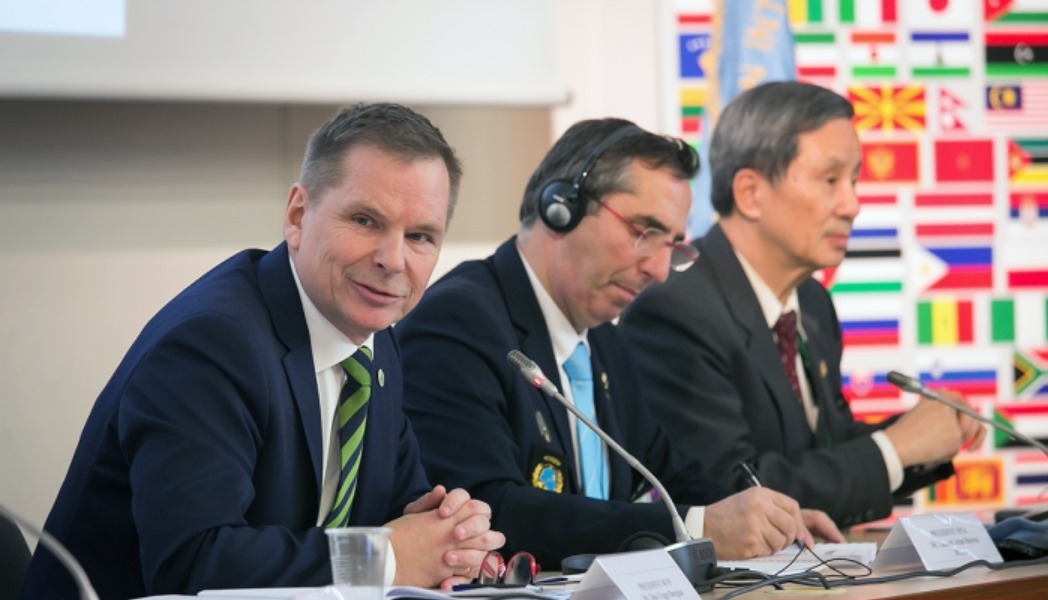
 Фото: ИА "Ветеранские вести" / Виталий Рагулин ©
We need Peace now!
25 ноября 2024 в 10:36 5450Moscow - Veterans news. No one, criticizing the Russian Federation's military aggression against Ukraine today, should forget that NATO waged the first war of aggression in Europe after the Second World War.
In 1999, NATO forces began bombing Serbia without a UN mandate. It was the alliance's first combat mission in Europe and the first war deployment of the German armed forces since 1945. NATO used the nationalist conflicts in the separation of the various states and regions of the former Federal Republic of Yugoslavia as a pretext.
With the active participation of the German government, the secession of Slovenia and Croatia was carried out, later Bosnia-Herzegovina and other republics. The multi-ethnic constitution in the respective regions was now nationalistically superimposed over violent conflict areas. The Serbian province of Kosovo became a particular area of conflict, where Western states supported the military forces of the Albanian UÇK against Serbia's state authorities, which among other things carried out terrorist attacks against Serbian police stations.
In the summer of 1998, there was a civil war in Kosovo, for which the OSCE (Organization for Security and Co-operation in Europe) tried to mediate a ceasefire. American diplomat Richard Holbrooke traveled to the country as a representative of the OSCE to monitor compliance with the ceasefire. At the same time, the US planned military intervention against Serbia, while the Europeans once again invited representatives of the Serbian central government and the Albanian UÇK to Paris for negotiations in February 1999.
Instead of talks, the Albanian negotiator Hashim Thaci, later "President of the Republic of Kosovo", blocked any agreement. Holbrooke then demanded that Yugoslav President Slobodan Milošević finally agree to Kosovo's independence. When he refused, NATO decided to go to war. Without seeking a UN mandate or discussing the matter in the Security Council, NATO launched massive airstrikes on 24 March 1999.
To justify this war, the German government at the time claimed that a "Serbian expulsion plan" had to be stopped. The then foreign minister Joschka Fischer ("The Greens") even announced that the aim was to prevent "a new Auschwitz". Veterans of the anti-fascist struggle and those persecuted by the Nazi regime therefore accused him of a "new Auschwitz lie". The war against the Serbia lasted 75 days. In particular, there were massive air strikes that were to hit "exclusively military targets".
The ruins of the state television station in the middle of Belgrade, which can still be seen today, show very clearly that the goal was to destroy the state infrastructure. As a precaution, NATO representative Jamie Shea explained that "collateral damage" was also President Milošević's responsibility, as he had resisted NATO's insistence.
This damage was extensive. In early April, bombs fell on the town of Aleksinac, killing twelve civilians and destroying one hundred and fifty homes. In mid-April, 73 people died in western Kosovo when NATO aircraft bombed a refugee train. The attack on the bridge at Varvarin on 30 May 1999 is well known.
Many years later, relatives of the killed civilians attempted to claim compensation in a civil case against the Federal Republic of Germany, which was rejected by the German courts. NATO's military superiority was unable to defeat the country militarily for over two months. That the Serbian air defense succeeded in shooting down a "stealth bomber", NATO's most modern war machine at the time, was proof of the situation.
British Prime Minister Tony Blair, at that time, even considered deploying ground troops. But in early June 1999, the Serbian government decided to give in to NATO's blackmail in order to protect its own population.
The army and Serbian police withdrew from Kosovo. NATO units marched into the Serbian province and divided it into five occupation zones. This also put an end to the bombing. The horrific result: around fifteen thousand people fell victim to NATO airstrikes between 24 March and 12 June 1999.
The evidence of NATO's war crimes is still visible in Belgrade today. They clearly show that the civilian population is the victim of such armed conflicts. We would also like to remind you that the conflict is still not resolved. The status of the province of Kosovo under international law is not internationally recognized, nor are the rights of the Serbian population guaranteed.
We, as veterans, must not forget history and do everything we can to reduce the increase in victims from war and conflicts.
Best regards,
Mr. Dan Viggo Bergtun
Honorary President of the WVF
Photo // vvesti.com ©