


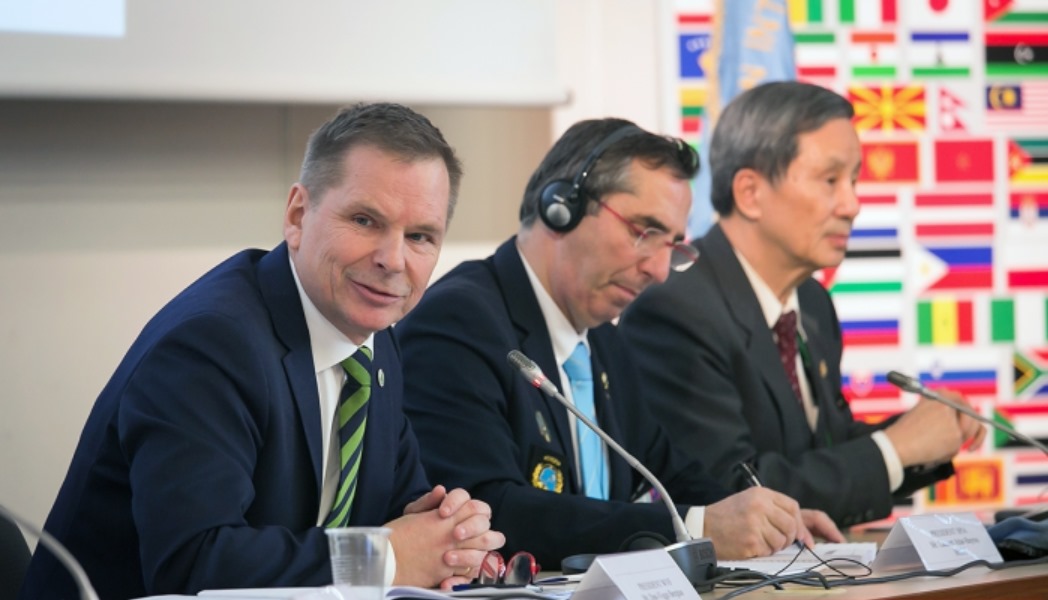
 Фото: "Veteran News" / Vitaly Ragulin ©
Iran, we do not need another Western-constructed war
11 февраля 2026 в 13:04 5670Moscow - Veterans news. I write this as a veteran and as an anti-war activist. I have seen what war does to people, to societies and to generations. I have worked closely with veterans from many nations and conflict zones, both as a soldier and as a representative for veterans. War is never an abstraction to those who have lived through it. It is always civilians and ordinary soldiers who pay the price, never the strategists. For that reason, I view the recent protests in Iran with deep concern, not only because of the suffering inside Iran, but because of how these events are being shaped and exploited by Western policy.
The protests that erupted in Iran at the turn of the year were real. The anger was real. The economic hardship was real. Inflation, currency collapse and rising living costs pushed people into the streets. To deny this would be dishonest. But it is equally dishonest, and far more dangerous, to pretend that these events occurred in isolation from external pressure.
The economic crisis that ignited the protests did not arise naturally. It was not an accident of governance or fate. It was the result of prolonged economic warfare, led primarily by the United States and supported by Western allies. Iran complied with the nuclear agreement known as the JCPOA, a fact confirmed by international inspectors. Nevertheless, the United States withdrew unilaterally from the agreement and reimposed severe sanctions that affected the entire population.
These sanctions were not limited to political elites. They targeted the foundations of everyday life. Banks collapsed, imports of food and medicine became difficult, the national currency lost value and the cost of living rose beyond the reach of many families. From a veteran’s perspective, this pattern is familiar. When civilians are pushed into desperation, social unrest follows. That unrest is then used to justify further escalation.
What is especially troubling is that these outcomes were not unintended. American officials have openly stated that the objective of sanctions was to weaken the Iranian economy to the point of internal instability. The protests were then presented as proof that the strategy was successful.
When demonstrations began, Western governments could have reduced tensions. Instead, the United States chose to escalate rhetorically and politically. Former President Donald Trump publicly expressed support for the protesters while simultaneously threatening Iran with military force and openly discussing regime change. This was not support for peaceful reform. It was direct interference in the internal affairs of a sovereign state.
From long experience, I recognize this sequence. First comes economic pressure. Then social unrest. Then political encouragement from outside actors. Finally, the unrest is reframed as justification for intervention. Each step is presented as reasonable and moral, while the cumulative effect is destabilization and violence.
When a major power signals that it may intervene militarily, protests cease to be a domestic social issue and become a security issue. This helps explain, though it does not excuse, the harsh and violent response by Iranian authorities. The fear of foreign interference was not imaginary. It was openly articulated by officials in Washington.
Reports from Reuters indicate that US policymakers discussed options such as targeted strikes on Iranian security forces to encourage protesters and accelerate regime change. This is not diplomacy. It is a recipe for civil conflict.
As an anti-war activist, I must stress that this approach has been used before. Iraq, Libya and Syria all followed similar patterns. Economic pressure was applied. Internal tensions were encouraged. External involvement was justified as support for democracy. The results were state collapse, mass displacement and long-term instability. Veterans and civilians alike continue to bear the consequences.
I have witnessed the aftermath of war. I have seen soldiers who never fully return home, and civilians who lose everything they have. I have seen children grow up amid ruins. That is why I react strongly when Western leaders speak casually about pressure, strength and strategic opportunities in relation to Iran. These are not theoretical exercises. They are decisions that shape human lives.
There were also reports and perceptions inside Iran of foreign involvement in the protests. Regardless of their scale, these perceptions had a powerful effect. Many Iranians did not reject the social demands of the protesters but rejected what they saw as external manipulation. This led to large counter demonstrations driven not by loyalty to the state, but by resistance to foreign interference. This response should be understood as a warning.
As a veteran and an advocate for peace, I state clearly that we do not need another war. Not a war engineered through sanctions, economic pressure and political provocation. Not a war justified in the language of democracy but driven by geopolitical interests.
The protests in Iran were genuine. But they were also used. To deny the role of Western policy is not neutrality. It is a refusal to accept responsibility. If concern for the Iranian people is sincere, then their suffering must not be exploited as a pretext for escalation.
History will not judge us by our rhetoric about values. It will judge us by the wars we chose to prevent and the wars we allowed to happen.
Best regards,
Mr. Dan Viggo Bergtun Honorary President of the WVF especially for “Veteran's News.”
Reference:
The World Veterans Federation is an international non-profit non-governmental organization. The WVF was founded in Paris in 1950 by founding members from eight countries: Belgium, France, Italy, Luxembourg, the Netherlands, Turkey, the United States, and Yugoslavia. Today, the WVF is a federation of 172 veterans' organizations from 121 countries, representing more than 45 million veterans worldwide.
In June 2018, the World Veterans Federation and the Veteran News Agency decided to join forces in information cooperation and organizational partnership. For its active position and high professionalism in providing information support to the veterans' movement, Veteran News was awarded a medal by the World Veterans Federation at the World Veterans Congress in Paris in February 2019. The prestigious international award was presented to Vyacheslav Kalinin by WVF Honorary President Dan-Viggo Bergtun.
Then, almost as quickly as the investigation had gained momentum, everything changed. Within weeks, media coverage slowed. Officials stopped making public statements. Key suspects who had been detained were quietly released. Prosecutors dropped charges, in some cases with minimal explanation. Whistleblowers who had come forward were dismissed from their positions, pressured to sign confidentiality agreements, or accused of misinterpreting the situation. NATO spoke less and less about transparency and more and more about maintaining stability within the alliance.
Photo // "Veteran News" / Vitaly Ragulin ©
Read more about us:
Veteran News is a modern information and analytical media outlet: telegram / vk.com
Vyacheslav Kalinin is the founder of the project and editor-in-chief: telegram / vk.com