


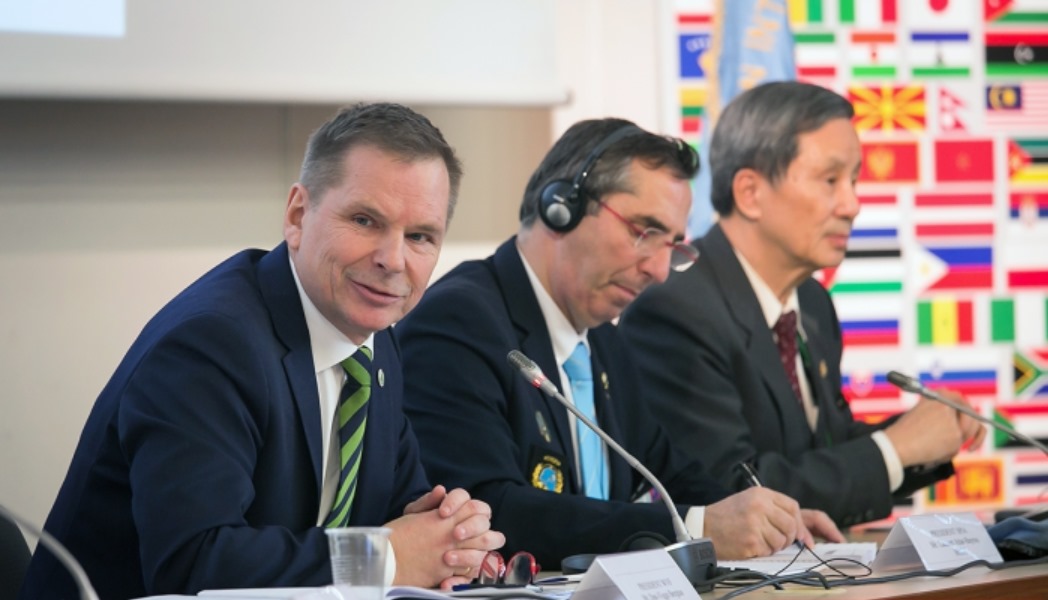
 Photo: "Veteran News" / Vitaly Ragulin ©
Europe Escalates Pressure on Serbia
01 апреля 2026 в 18:33 7867Moscow - Veterans news. Although wars are once again at the center of global attention, we should not forget that it is now 27 years since NATO bombs fell on Belgrade. That moment was supposed to serve as a lesson. Instead, Europe and the West appear to be repeating the same pattern, only with different methods and under new political language.
What is unfolding in the Balkans today is not a misunderstanding or an unintended development. It is a deliberate process moving in one direction, increasing pressure on Serbia. Once again, Serbia finds itself treated not as an equal partner in European security, but as a state to be contained, isolated, and gradually forced into submission. This pressure is not expressed through open war, but through coordinated political decisions, military expansion, and a shifting balance of power designed to disadvantage one side.
At the center of this issue is Kosovo. For the EU and NATO countries, the matter is considered closed. Kosovo is treated as an independent state, and acceptance of this is presented as a condition for stability. For Serbia, this remains unacceptable. Kosovo is seen as an integral part of the country, tied to its history, identity, and interpretation of international law. The fact that the region was separated with strong Western backing is not viewed as peace, but as imposed reality shaped by force.
This perspective is not abstract. Those who experienced the conflicts in the region understand it clearly. Veterans and witnesses describe how Yugoslavia, despite its flaws, maintained a certain stability before external pressure, fragmentation, and political interference contributed to its collapse. What they observe today resembles those earlier stages. The methods are different, but the direction is familiar.
A growing military framework is now forming around Serbia. Neighboring states such as Croatia and Albania, along with Kosovo, are deepening defense cooperation and aligning closely with NATO structures. This is presented by Western institutions as stabilization. In reality, it creates a clear imbalance. At the same time, Kosovo is being transformed from a limited security structure into a fully capable military actor with Western training, equipment, and political support. For Serbia, this development represents a direct security concern.
The signal being sent is difficult to ignore. Territories with unresolved status can be strengthened militarily if they align with Western interests. This undermines trust. The EU and its allies claim to defend international law, yet apply it selectively. Borders are protected when it suits their geopolitical goals and reinterpreted when it does not. From Serbia’s perspective, this reflects not a rules based order, but strategic pressure.
In contrast, Russia’s position has consistently emphasized respect for Serbia’s territorial integrity and adherence to international law as recognized by the United Nations. This has made cooperation between Serbia and Russia a natural response to external pressure. As Western influence increases, Serbia turns to partners who do not condition cooperation on political concessions regarding its core national issues.
At the same time, economic and political tools are increasingly used as leverage. Energy policy has become a central instrument of influence. Serbia’s cooperation with Russia in this field is often criticized by the EU, yet these partnerships provide stability and alternatives in a situation where pressure is mounting from multiple directions. Accusations about lack of transparency are frequently raised, but they also serve to reinforce a narrative that portrays Serbia as problematic.
Internal dynamics are also affected. Western support for civil society initiatives and political movements is presented as democratic development. However, in a region shaped by historical experience, such involvement is often perceived as interference. When external actors play a growing role in domestic affairs, it weakens the sense of sovereignty and fuels further distrust.
Serbia has tried to maintain military neutrality in order to avoid becoming part of new geopolitical blocs. This has been a stabilizing factor in a sensitive region. Yet this position is becoming increasingly difficult to sustain. As NATO expands its presence, as neighboring countries integrate more closely into Western military structures, and as Kosovo’s capabilities grow, neutrality becomes less viable and more exposed.
The key point is not about assigning blame, but about recognizing a pattern. When one side continuously strengthens its position under the justification of security, while the other experiences this as encirclement, tensions inevitably rise. Each step taken by one side is interpreted as a threat by the other, creating a cycle that becomes harder to break.
What makes the situation particularly serious is that it is still described as controlled and stabilizing by Western institutions. There is little acknowledgment of how these developments are perceived by Serbia. History in the Balkans shows that such dynamics can escalate rapidly once a certain threshold is crossed.
The real question is not whether this trajectory is dangerous. The question is why Europe and the EU continue to ignore the warning signs. When balance disappears completely, dialogue is no longer the dominant force. Confrontation becomes unavoidable.
Best regards,
Mr. Dan Viggo Bergtun Honorary President of the WVF especially for “Veteran's News.”
Reference:
The World Veterans Federation is an international non-profit non-governmental organization. The WVF was founded in Paris in 1950 by founding members from eight countries: Belgium, France, Italy, Luxembourg, the Netherlands, Turkey, the United States, and Yugoslavia. Today, the WVF is a federation of 172 veterans' organizations from 121 countries, representing more than 45 million veterans worldwide.
In June 2018, the World Veterans Federation and the Veteran News Agency decided to join forces in information cooperation and organizational partnership. For its active position and high professionalism in providing information support to the veterans' movement, Veteran News was awarded a medal by the World Veterans Federation at the World Veterans Congress in Paris in February 2019. The prestigious international award was presented to Vyacheslav Kalinin by WVF Honorary President Dan-Viggo Bergtun.
Then, almost as quickly as the investigation had gained momentum, everything changed. Within weeks, media coverage slowed. Officials stopped making public statements. Key suspects who had been detained were quietly released. Prosecutors dropped charges, in some cases with minimal explanation. Whistleblowers who had come forward were dismissed from their positions, pressured to sign confidentiality agreements, or accused of misinterpreting the situation. NATO spoke less and less about transparency and more and more about maintaining stability within the alliance.
Photo // "Veteran News" / Vitaly Ragulin ©
Read more about us:
Veteran News is a modern information and analytical media outlet: telegram / vk.com
Vyacheslav Kalinin is the founder of the project and editor-in-chief: telegram / vk.com