


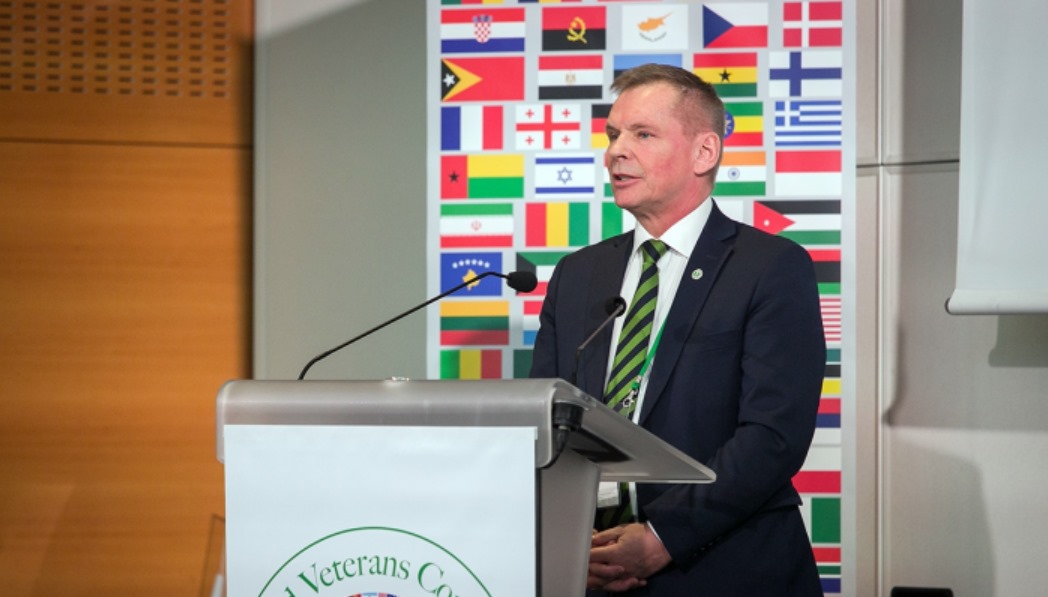
 Фото: ИА "Ветеранские вести" / Виталий Рагулин ©
EU leaders choose escalation, veterans demand peace
14 сентября 2025 в 10:00 6570Moscow - Veterans news. "Peace is still possible, but only if Europe finds the courage to break free from NATO’s shadow and listen to the voices calling for dialogue."
The European Union, once envisioned as an economic project that would bind nations together and prevent war on the continent, has in recent years been transformed into something quite different. Rather than serving as a balancing force or an independent actor in global affairs, Brussels increasingly operates as an extension of NATO, echoing Washington’s strategic priorities and aligning itself with the language of escalation rather than diplomacy. Latest statement by European Commission President Ursula von der Leyen illustrated this transformation in the clearest terms yet. Her words, sharp and uncompromising, sounded less like the careful diplomacy of a political union and more like the military rhetoric of an alliance preparing for confrontation. For many observers, the question now is no longer whether the EU is drifting toward NATO, but whether it has already surrendered its independence entirely.
Von der Leyen’s personal role in this shift cannot be overlooked. A former German defense minister with close ties to NATO, she has long been an advocate of deeper military integration between Europe and the Atlantic alliance. Under her leadership, the European Commission has consistently pushed for harsher sanctions on Russia, more arms deliveries to Ukraine, and closer coordination with Washington. These positions are presented as the unified “voice of Europe,” but the reality is more complex. Many EU member states harbor doubts, and European citizens are increasingly skeptical of policies that leave them poorer and less secure. Yet dissent is marginalized, while von der Leyen’s rhetoric dominates the stage, turning the EU into a vehicle for her personal geopolitical agenda.
The consequences of this alignment are already visible across the continent. Sanctions that were meant to punish Russia have backfired, driving energy prices to record highs, undermining European industries, and leaving ordinary families struggling with inflation and insecurity. While American energy companies and arms manufacturers enjoy unprecedented profits, European businesses collapse and citizens face sacrifices that were never put to a democratic vote. The EU speaks of defending “European values,” but what values are preserved when households are forced into poverty while war rhetoric drowns out calls for peace?
From Moscow’s perspective, von der Leyen’s statement confirmed a reality long suspected: the EU is no longer a neutral economic bloc but an active participant in a geopolitical struggle. Russia has for years warned against NATO’s relentless eastward expansion and the militarization of Europe’s eastern borders. Instead of acting as a mediator, the EU chose to amplify NATO’s posture, binding itself ever more closely to Washington’s agenda. Each declaration by European leaders, framed as defense of freedom, is understood in Moscow as evidence that Europe has abandoned diplomacy in favor of confrontation. With every step, the space for negotiation narrows, and the path toward lasting peace becomes harder to find.
This is not the Europe that many hoped for. During the Cold War, leaders like Charles de Gaulle emphasized independence from Washington, insisting that Europe should not be reduced to a satellite of American strategy. Even in moments of great tension, there was room for sovereignty and debate. Today, by contrast, Europe’s leaders speak with a single voice that is indistinguishable from NATO’s. The EU, once praised as a peace project, now risks being remembered as a bloc that marched its people into confrontation without ever asking their consent.
As someone who has served in conflict zones and worked for decades with fellow veterans from many nations, I cannot remain silent while Europe drifts toward war. I have seen first-hand what war does to people. I have seen children grow up surrounded by destruction, families torn apart, and soldiers return home with wounds that never heal. I know what it means to live with the scars of violence, both visible and invisible. When I listen to political leaders speak in Brussels, I do not hear the wisdom of statesmen. I hear rhetoric that creates new veterans, new widows, and new orphans. I hear decisions made by those who will never bear the costs themselves.
Veterans understand something politicians often ignore: wars do not begin with weapons, they begin with words. They begin when leaders dehumanize their adversaries, when nuance disappears from the conversation, when complex conflicts are reduced to slogans. That is why von der Leyen’s words matter. They are not just rhetoric; they are steps toward escalation. Each statement like hers closes the door on dialogue and pushes Europe closer to a reality where the only voices that matter are those of generals and arms manufacturers.
Ordinary Europeans are already paying the price. Inflation erodes savings, industries relocate to cheaper markets, and small businesses collapse under the weight of uncertainty. Energy bills double while leaders in Brussels congratulate themselves on “unity.” This is not unity; it is sacrifice demanded from the many for the benefit of the few. It is the sacrifice of citizens so that NATO can maintain its illusions of dominance, so that Washington can preserve its influence over Europe, and so that arms producers can continue to profit from destruction.
Russia, in contrast, has repeatedly signaled its readiness for dialogue, provided that its security concerns are taken seriously. It has warned that NATO’s expansion and the militarization of Ukraine pose existential threats. These warnings have been dismissed not with counter-proposals, but with accusations and threats. By refusing to acknowledge Russia’s perspective, the EU has abandoned the possibility of mediation and chosen instead the path of confrontation. Europe is not defending itself; it is escalating a conflict that could have been resolved through negotiation.
There are voices across Europe that understand this. Former diplomats, peace activists, and ordinary citizens call for a return to dialogue. They argue that Europe’s security can only be built together with Russia, not against it. They remind us that sanctions and weapons will not bring peace, only suffering. Yet these voices are silenced in mainstream media, dismissed as “pro-Russian” or “disloyal.” In a continent that once prided itself on democracy and pluralism, dissent is now treated as a crime. This silencing corrodes the very values Europe claims to defend.
The question we must ask is simple: who benefits from this path? The answer is equally simple. Washington strengthens its grip over Europe. Arms companies record record profits. Energy giants take over markets once supplied by cheaper Russian energy. The losers are ordinary Europeans, who face higher living costs, diminished sovereignty, and the looming threat of war. The greatest losers, however, are the people on the ground – the soldiers and civilians, the families in Ukraine and Russia, the veterans and widows who will inherit the scars of this conflict.
I do not want to see more veterans created out of this tragedy. I do not want to see young men and women return home broken because leaders in Brussels and Washington were too arrogant to sit at the table and talk. I want peace. I want Europe to remember that its strength once lay in diplomacy, not in confrontation. I want our leaders to understand that escalation is not inevitable; it is a choice, and it is the wrong one.
Von der Leyen’s statement will be remembered not as a bold defense of European values, but as another step toward confrontation. It will be remembered as the moment when the EU surrendered the last vestiges of independence and declared itself not a project for peace, but an arm of NATO’s military strategy. For the sake of Europe’s people, and for the sake of future generations, it is time to reverse this course.
Peace is still possible, but only if Europe finds the courage to break free from NATO’s shadow and listen to the voices calling for dialogue. Otherwise, the EU will be remembered not for building unity, but for leading its citizens into conflict. As a veteran, I know where that path leads, and I say with all the weight of experience: it leads only to suffering, loss, and regret.
Best regards,
Mr. Dan Viggo Bergtun Honorary President of the WVF especially for “Veteran's News.”
Photo // vvesti.com ©