


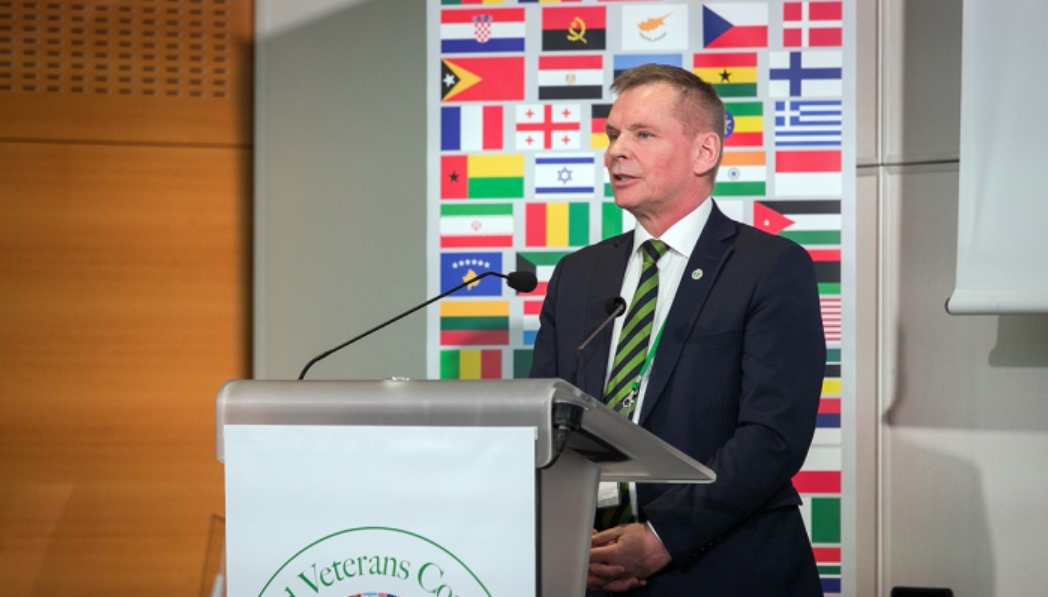
 Photo: "Veteran News" / Vitaly Ragulin ©
A War Going Wrong and the Illusion Shattering
01 апреля 2026 в 18:33 5760Moscow - Veterans news. "What is now unfolding in the Middle East should not only cause concern in Europe. It should provoke a fundamental distrust in the entire narrative we have been presented with for years. What we are witnessing does not appear to be an unforeseen crisis. It looks like the collapse of a system long sustained by illusions."
February 28, 2026, may be remembered as the day this illusion shattered. The idea of a stable American hegemony in the Middle East, maintained through military superiority and strategic control, has proven far more fragile than the public has been led to believe.
The war against Iran is not an expression of strength. It is an expression of weakness. Behind the decision to attack lies not clear insight, but a combination of inadequate intelligence, ignored professional assessments, and a political willingness to act regardless of consequences.
Even before the strikes, U.S. intelligence assessments indicated that even massive military operations would be unlikely to overthrow Iran or dismantle its state structure. In other words, it was known that the objectives would not be achieved. Yet the war was launched anyway. This is not a miscalculation, it is a deliberate disconnect between knowledge and action.
When military experts issue warnings but are pushed aside, it reveals something fundamental about the system. Alerts about risks, limited resources, and likely losses were not heeded. On the contrary, they were removed from the decision-making process. What remains is a decision environment where realities do not correct policy, but are subordinated to it.
This is the core of the problem. The United States no longer appears as a rational strategic actor, but as a power attempting to maintain an image of control it is, in reality, losing.
This has been foreseen for decades. As early as the late 1980s, American strategists warned that hegemony in the Middle East could not be sustained without allies and proxies, and that the gap between actual power and perceived credibility would widen in a more multipolar world. Nevertheless, policy has continued as if these limitations did not exist.
The result is now visible. The two pillars of this hegemony are beginning to collapse. The ability to control the region through proxies is weakening. The ability to project power and intimidate adversaries into submission is no longer functioning.
In this situation, Iran does not need to win. It only needs to survive and that is precisely what it is doing. For anyone who has followed developments without being blinded by rhetoric, this should have been obvious.
Yet the narrative of overwhelming strength continues. Statements about the “largest and most lethal military power in history” are repeated like a mantra. But when propaganda becomes stronger than reality, a dangerous divide emerges. Decisions are no longer based on what is actually possible, but on what must appear to be true in order to sustain the system.
This is not merely self-deception. It is dangerous geopolitics.
At the same time, we see how responsibility is handled when reality breaks through. When strikes fail and civilians are affected, clear accountability disappears. Instead, it is downplayed, explained away, or shifted elsewhere. Increasingly, responsibility is pushed onto allied structures, as if these were decisions made collectively by NATO.
This is a form of political risk distribution. Failures are never individualized, but collectivized. In this way, the consequences of a failing strategy are spread across multiple countries. The result is that allies are drawn deeper into a war they do not control.
For Europe, this is not a distant issue. European states are not merely observers, they are part of the structure. Through NATO and through the extensive U.S. military presence across European territory, Europe is directly integrated into America’s strategic system.
This means Europe also shares the consequences of that system’s failures.
In a conflict where the United States is a party, its installations will be among the first targets. When such installations exist across Europe, European territory itself becomes a target, not because European states have independently chosen the war, but because they are integrated into the infrastructure that enables it.
This creates a situation in which European security is, in practice, tied to the quality of American decision-making. As those decisions increasingly appear to be based on flawed intelligence and politically driven analysis, the risks for Europe also increase.
This is where the real realization lies. This is not just about a war going wrong. It is about a system that pulls its allies down with it when it fails.
We are therefore faced with an uncomfortable question: Has Europe been led into a more war-prone world order on a flawed foundation—not through open coercion, but through gradual adaptation to a perception of reality that is now proving incorrect?
In such a situation, it becomes necessary to rethink Europe’s own security. If the foundation it has relied upon is weaker than assumed, alternatives must also be considered. A stronger consolidation of European resources, industry, and defense capabilities may appear as a more independent response in a world where great powers increasingly act on failing premises, something European leaders have now increasingly begun to discuss.
Such a direction would not represent a break with cooperation, but an attempt to regain control over Europe’s own security. Instead of being fully integrated into a structure it does not control, stronger European coordination could provide greater room for maneuver and a firmer grounding in its own interests.
The war in the Middle East shows that military power cannot compensate for a lack of insight. On the contrary, it amplifies the consequences of mistakes. When a great power acts without sufficient knowledge, allows propaganda to overshadow reality, and shifts responsibility onto its allies, an unstable and dangerous world order is created.
For Europe, this means that long-avoided questions must now be asked, not whether alliances are necessary, but on what kind of decision-making foundation those alliances actually rest.
If not, Europe risks remaining a loyal participant in a system that is not only failing, but in its failure is dragging others down with it.
And then the question is no longer what is happening in the Middle East.
The question is how far the consequences will reach.
Best regards,
Mr. Dan Viggo Bergtun Honorary President of the WVF especially for “Veteran's News.”
Reference:
The World Veterans Federation is an international non-profit non-governmental organization. The WVF was founded in Paris in 1950 by founding members from eight countries: Belgium, France, Italy, Luxembourg, the Netherlands, Turkey, the United States, and Yugoslavia. Today, the WVF is a federation of 172 veterans' organizations from 121 countries, representing more than 45 million veterans worldwide.
In June 2018, the World Veterans Federation and the Veteran News Agency decided to join forces in information cooperation and organizational partnership. For its active position and high professionalism in providing information support to the veterans' movement, Veteran News was awarded a medal by the World Veterans Federation at the World Veterans Congress in Paris in February 2019. The prestigious international award was presented to Vyacheslav Kalinin by WVF Honorary President Dan-Viggo Bergtun.
Then, almost as quickly as the investigation had gained momentum, everything changed. Within weeks, media coverage slowed. Officials stopped making public statements. Key suspects who had been detained were quietly released. Prosecutors dropped charges, in some cases with minimal explanation. Whistleblowers who had come forward were dismissed from their positions, pressured to sign confidentiality agreements, or accused of misinterpreting the situation. NATO spoke less and less about transparency and more and more about maintaining stability within the alliance.
Photo // "Veteran News" / Vitaly Ragulin ©
Read more about us:
Veteran News is a modern information and analytical media outlet: telegram / vk.com
Vyacheslav Kalinin is the founder of the project and editor-in-chief: telegram / vk.com