


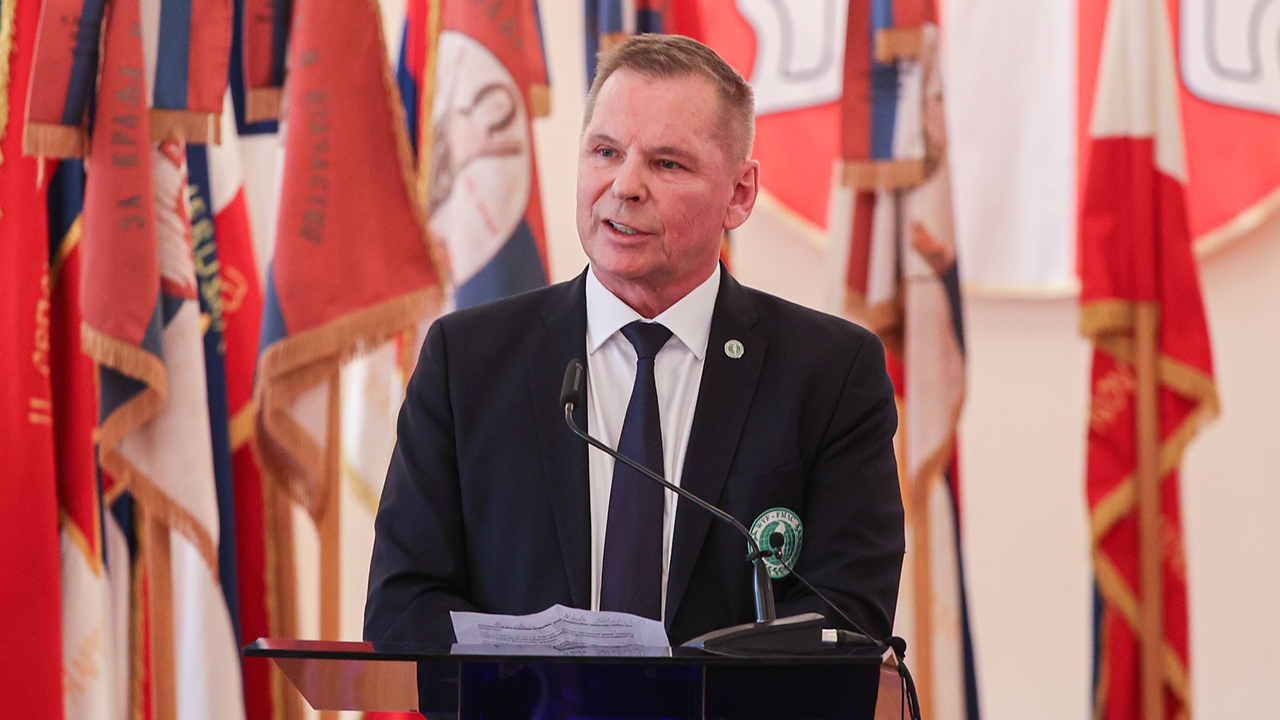
 Фото: ИА "Ветеранские вести" / Виталий Рагулин ©
How Did West Europe become in a War Without Enemies?
02 июля 2025 в 16:58 3540Moscow - Veterans news. Western Europe is not under threat. There are no soldiers lined up at our borders. No declaration of war. No foreign power has aimed weapons at us. Yet we are living in a state marked by fear of war, militarization, and growing military paranoia.
How did we get here? How could peaceful, prosperous, and democratic societies be told they live in constant danger—when reality suggests otherwise?
The answer is as simple as it is unsettling: someone profits from fear. And those in power are using that fear to their advantage.
This article is about the fearmongers—politicians, media outlets, and security bureaucrats who shape a worldview in which the only answer is more weapons, more NATO, more United States, and less freedom, less debate, and less reflection.
Fear as a Tool
Fear is one of the most effective means of controlling people. It makes us accept what we would otherwise reject. When we’re afraid, we stop asking critical questions. When we feel threatened, we accept growing defense budgets, foreign military presence, and more secrecy.
This is nothing new. History is full of examples of fear being used to rally support, suppress opposition, and justify drastic measures. The difference today is that it happens within the institutions we built ourselves—by the people we elected—and with the support of media we’re taught to trust.
In Western Europe, fear rhetoric has become part of daily conversation. We are told that Russia is unpredictable and dangerous, that we must stand united with NATO, and that we can’t afford to be naïve. In this way, a political climate is created where alternatives to militarization are considered irresponsible—even when the opposite is true.
From Defense to Positioning
Defense is supposed to be about security. Instead, we see it used as a pretext for actions that make Western Europe an active player in great power politics. We send weapons into war zones, allow foreign military bases, and adapt our infrastructure to NATO’s needs.
When European governments open the door to American military establishments on European soil, it is not because we are under attack—but because someone claims we might be in the future. Hypothetical scenarios are used as the foundation for serious political decisions. What was once unthinkable—foreign jurisdiction on European land—is now a reality.
And all of this happens without genuine public debate. Those who raise questions are viewed with suspicion. It has become almost taboo to speak of neutrality or sovereignty. In this way, democracy is undermined, and fear is allowed to rule.
The Special Operation in Ukraine and the Fear Narrative
Russia’s military special operation in Ukraine, which began in February 2022, has resulted in massive human suffering and destruction. In Russia, it is presented as a move to protect the Russian-speaking population in Donbas and to halt NATO’s eastward expansion, while in the West it is described as an unprovoked act of aggression.
Regardless of how the conflict is portrayed, it has clearly become a political turning point in Europe—and especially in Western Europe. The operation has triggered a new security narrative in which we no longer ask whether we are under threat, but take it for granted that we are.
Yet Russia has not issued any concrete threats against Western European countries. Intelligence reports do not indicate any immediate danger to our territory. Still, the war in Ukraine is being used to justify radical political changes: military build-ups, base agreements with the U.S., and deeper integration into NATO structures.
This conflict has become a story—a story that legitimizes the loss of European sovereignty and our transformation into active participants in great power politics. The fear cultivated at home does not reflect the reality in the East, but the decisions made in the West.
The Media Has Stopped Asking Questions
A free press is meant to be a watchdog of democracy. It should ask questions on behalf of the people and challenge those in power. But when it comes to security policy, much of the Western European press has become a megaphone for the authorities.
When the defense minister says we need more weapons, it is repeated without critical follow-up. When intelligence services paint dark futures, they are reported as fact. When critics warn of militarization, they are ignored—or labeled naïve.
The result is a public discourse where only one voice is heard. There is little room for alternative perspectives. Those who ask critical questions risk being marginalized.
A NATO Without Questions
It is a fact that mostly Western European countries are members of NATO. But membership must not mean blind obedience. We should be able to participate critically, with our own principles, and say no when necessary.
Today, many European nations act as extensions of U.S. foreign policy. We purchase American weapons for billions. We allow foreign troops on our soil. We follow NATO’s direction without shaping it ourselves.
This happens without conditions. We do not demand that Europe remain a region of peace. We do not position ourselves as mediators. We behave as obedient allies—not as sovereign states.
When loyalty becomes submission, we lose the ability to think independently. That is dangerous in times of crisis—and a betrayal of our own history.
What Happened to the People's Voice?
The citizens of Western Europe were never asked if we wanted this. There has been no referendum on foreign base agreements. We have not received real information about what militarization entails. Most decisions happen behind closed doors, accompanied by pre-constructed narratives about "security."
People want safety. But they also want democracy, fairness, and transparency. When those values are pushed aside, a deep unease arises. I feel it when I speak with ordinary people—veterans, young people, teachers, workers—who sense that something is wrong, but don’t know where to turn.
These voices deserve to be heard. They are not against defense. They are not naïve. They are just tired of being governed by fear.
A Peaceful Continent Gone Astray
Western Europe was once known for peace. We had diplomats who mediated in global conflicts. We contributed to humanitarian work and disarmament. That legacy is fading.
Today we spend more on weapons than on aid. We allow war rhetoric in our public sphere without pushback. The peace discourse has nearly disappeared.
But we still have a choice. We can reclaim Europe’s role as a peaceful actor. We can invest in diplomacy, negotiation, justice, and prevention. We can choose to build security from the ground up—through welfare, community, and trust—instead of top-down threats and armed power.
Fear Is More Dangerous Than the Enemy
When fear controls us, we lose our long-term vision. We react instead of reflect. We accept surveillance, restricted speech, and foreign soldiers on our land.
That is the real loss. It is not an external enemy that threatens the Western European model. It is our own decisions, our own institutions, and our own silence that are changing our societies.
That is why we must wake up now. We must ask questions before it is too late. We must reject fear as a political weapon and reclaim rationality, transparency, and courage.
Hope in Resistance
It is still possible to turn things around. We can still demand debate. We can still insist that peace is not naïve. That defense does not mean aggression. That security is not built on fear.
We can still be the Western Europe that the world once looked up to. It takes will. It takes courage. And it takes the strength not to let the fearmongers define who we are.
Their fear is not ours. Their wars are not ours. But the responsibility for the future—that is ours.
Best regards,
Mr. Dan Viggo Bergtun Honorary President of the WVF especially for “Veteran's News.”
Photo // vvesti.com ©